After Roposo Clout Shutdown — Where Are Indian Fashion Resellers Going in 2026?
Quick Summary
In April 2026, Roposo Clout officially shut down its reseller and creator commerce platform, leaving thousands of Indian fashion resellers without a selling channel overnight. For many, Roposo Clout was their primary source of income — a platform that combined social commerce, product sourcing, and commission-based reselling in one place. Its closure has forced resellers to rethink their entire business model. This article explains what happened, why the shutdown matters, and most importantly, where smart Indian fashion resellers are moving in 2026. Whether you are a beginner looking to restart or an experienced reseller ready to upgrade, this guide will walk you through the best alternatives, the smartest models to adopt, and the suppliers that can genuinely support your growth long term.
Introduction: When the Platform You Relied On Disappears
Building a business on someone else's platform is always a risk. Thousands of Indian fashion resellers discovered this the hard way when Roposo Clout shut down in April 2026.
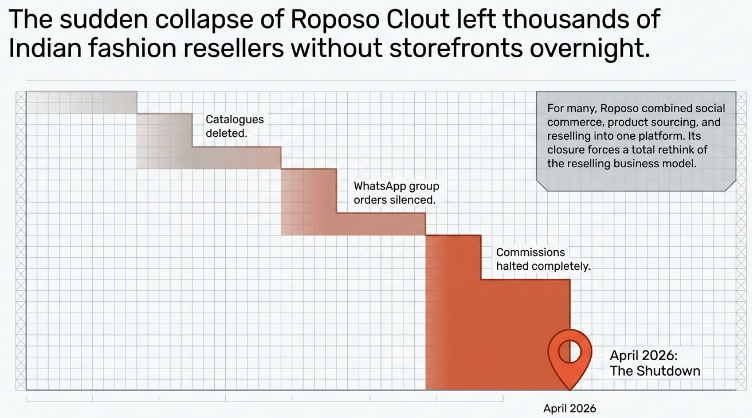
For many resellers, the shutdown was sudden. Commissions stopped. Catalogs disappeared. WhatsApp groups that once buzzed with orders went quiet. The question everyone started asking was the same: what now?
The good news is that the Indian fashion reselling market itself is not shrinking. Demand for affordable women's clothing, ethnic wear, and lingerie online continues to grow. What changed is the channel — and that is actually an opportunity in disguise.
Resellers who were dependent on Roposo Clout are now actively looking for three things: a reliable product source, a business model they control, and a platform that will not disappear. This article covers exactly that.
What Was Roposo Clout and Why Did It Shut Down?
Roposo Clout was a social commerce platform that allowed influencers, micro-resellers, and creators to earn commissions by promoting and selling products from a central catalog. It was popular among Indian women's fashion resellers because it required no upfront investment — you shared a product link, someone bought it, and you earned a cut.
The model worked during a period of aggressive platform spending. But as investor funding tightened across Indian startups in 2024–2025, platforms like Roposo Clout faced a sustainability problem. Commission-based social commerce platforms burn money heavily on logistics, seller payouts, and catalog management without building a loyal, repeat-purchase customer base.
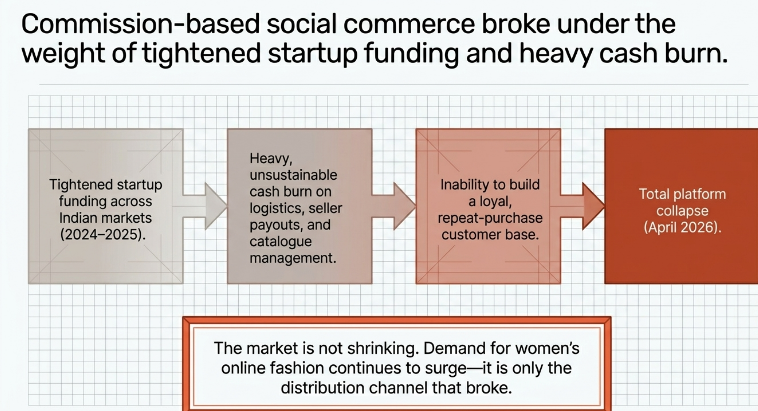
By April 2026, the platform announced it was discontinuing its reseller commerce operations. Thousands of active resellers were left without a storefront, without a catalog, and without income.
The core lesson: commission-based reselling on third-party platforms is inherently fragile. When the platform goes, your business goes with it.
The 3 Business Models Resellers Are Moving To in 2026
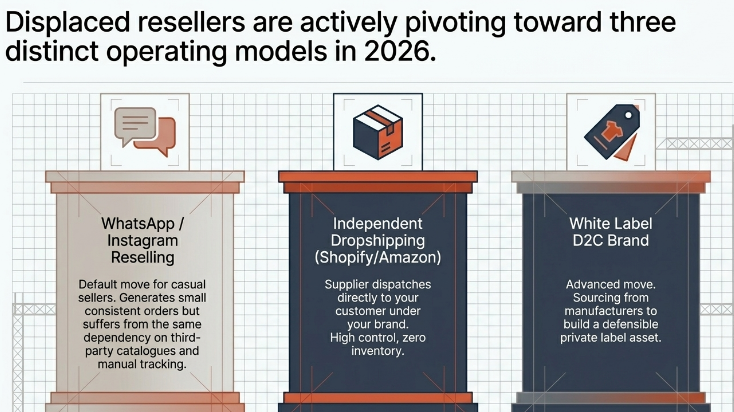
After the Roposo Clout shutdown, Indian fashion resellers are broadly moving toward three models. Each has different risk levels, investment requirements, and income potential.
| Business Model | Investment Required | Control Level | Income Potential | Best For |
|---|---|---|---|---|
| WhatsApp/Instagram Reselling | Very Low | Low | Limited | Casual sellers |
| Dropshipping (Shopify/Amazon) | Low–Medium | High | High | Growth-focused resellers |
| White Label D2C Brand | Medium | Very High | Very High | Experienced sellers |
Model 1: WhatsApp and Instagram Reselling
Many former Roposo Clout resellers have defaulted to sharing product images on WhatsApp groups and Instagram. This works for generating small, consistent orders but it has the same fundamental problem as Roposo Clout — you are still dependent on someone else's platform and catalog.
Margins are typically low, order tracking is manual, and scaling beyond a certain point is nearly impossible without a proper storefront.
Model 2: Dropshipping Through Shopify or Amazon
This is where the most significant shift is happening. Dropshipping gives resellers full control over their storefront, pricing, branding, and customer relationships. You do not hold inventory — your supplier dispatches directly to your customer under your brand.
For fashion resellers who understand the product, this is a natural upgrade. The supplier handles manufacturing and shipping. You focus on marketing and customer acquisition.
If you are considering this route, starting dropshipping on Shopify is one of the most beginner-friendly entry points available in India today.
Model 3: White Label D2C Brand
The most advanced move is building a private label fashion brand — sourcing from a manufacturer, adding your own brand name, and selling directly to consumers. This requires more investment and planning but creates a real, defensible business asset.
Suppliers who offer white label dropshipping services make this model accessible even for first-time brand builders, handling production and packaging under your brand name.
Why Dropshipping Is the Smartest Move for Most Roposo Clout Resellers
For the majority of displaced Roposo Clout resellers, dropshipping is the most practical and scalable next step. Here is why.
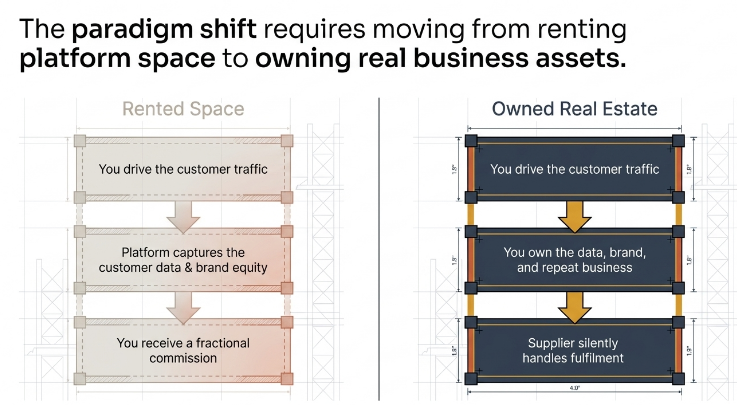
You already have the skills. If you were successfully selling on Roposo Clout, you understand product photography, fashion trends, pricing, and what your audience wants to buy. These skills transfer directly to running a dropshipping store.
The entry barrier is low. Unlike a traditional retail business, dropshipping requires no inventory investment. You only pay for products after a customer has already paid you.
You own the customer relationship. Unlike commission-based platforms, your own store means your customer data, your repeat purchase rate, and your brand — not someone else's.
Platforms are stable and growing. Shopify has deep roots in the Indian market. Amazon India's seller ecosystem continues to expand. These are not startup experiments — they are established commerce infrastructure.
Choosing a Clothing Dropshipping Supplier in India: What to Look For
The most critical decision after choosing your business model is choosing your supplier. This is where many resellers make expensive mistakes — picking a middleman reseller catalog that has inconsistent stock, slow dispatch, and no accountability.
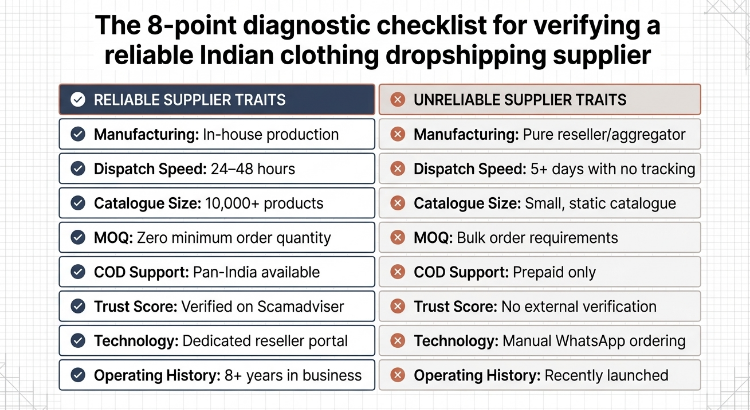
Here is what separates a genuinely reliable clothing dropshipping supplier in India from the rest:
| Criteria | What to Look For | Red Flag |
|---|---|---|
| Manufacturing | In-house production | Pure reseller/aggregator |
| Dispatch Speed | 24–48 hours | 5+ days with no tracking |
| Catalog Size | 10,000+ products, multiple categories | Small, static catalog |
| MOQ | No minimum order quantity | Bulk order requirements |
| COD Support | Pan-India COD available | Prepaid only |
| Trust Score | Verified on Scamadviser/Reviews.io | No external verification |
| Seller Dashboard | Dedicated reseller portal | Manual order via WhatsApp |
| Years in Business | 8+ years | Recently launched |
If a supplier cannot clearly answer all eight of these criteria, it is not a foundation you want to build a business on.
Shopify vs Amazon: Which Platform Should You Use?
One of the most common questions from former Roposo Clout resellers restarting in 2026 is whether to sell on Shopify or Amazon India.
Both have merit. The right answer depends on your goals.
For a detailed breakdown of both platforms for clothing dropshipping specifically, this comparison of Shopify vs Amazon for clothing dropshipping in India covers the decision clearly.
At a high level:
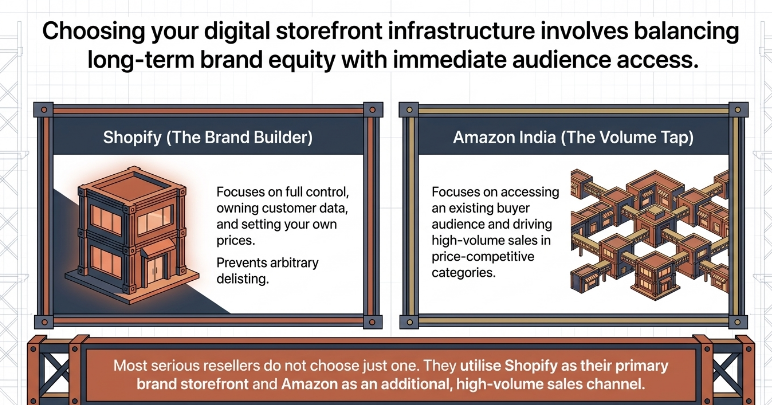
Shopify is better if you want to build a brand, own your customer data, and have full control over pricing and presentation. Your store is yours. No platform can delist you arbitrarily.
Amazon India is better if you want access to an existing buyer audience and are comfortable competing on price. It works well for high-volume, price-competitive categories. For a full walkthrough on this model, see how to dropship on Amazon India.
Most serious resellers eventually use both — Shopify as their primary brand storefront and Amazon as an additional sales channel.
Pros and Cons of Moving From Roposo Clout to Dropshipping
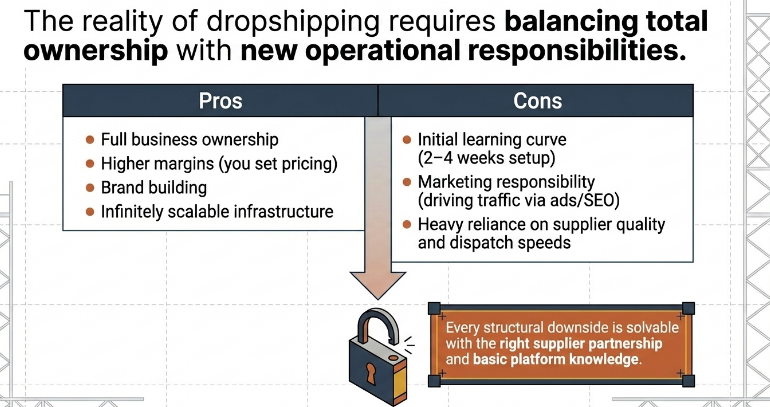
Pros
- Full business ownership — no platform can shut your income overnight
- Higher margins — you set your own pricing, not a commission structure
- Brand building — your customers, your data, your repeat purchases
- Scalable — from one order a day to hundreds with the same infrastructure
- No inventory risk — supplier holds stock, you pay only after selling
- Multiple platform options — Shopify, Amazon, Instagram Shop, WhatsApp Commerce
Cons
- Learning curve — setting up a Shopify store requires initial effort
- Marketing responsibility — you must drive your own traffic (ads, SEO, social)
- Supplier dependency — quality and dispatch depend on your supplier choice
- Initial setup time — takes 2–4 weeks to properly set up compared to instant onboarding on Roposo Clout
The cons are all solvable with the right supplier partnership and basic platform knowledge. The pros represent a fundamentally more resilient business.
Our Recommendation
For Indian fashion resellers who were active on Roposo Clout and are now rebuilding, the clearest path forward is a Shopify-based dropshipping store powered by a manufacturer-backed Indian supplier.
Do not default back to another commission platform. The structural problem with those models has not changed. Instead, invest 2–3 weeks setting up a proper store — the business you build is yours permanently.
When evaluating suppliers, look specifically for manufacturers who have been operating for a decade or more, carry a large women's fashion and lingerie catalog, offer no-MOQ dropshipping, and have verifiable third-party trust ratings. These are not common. Most supplier directories are full of aggregators and middlemen.
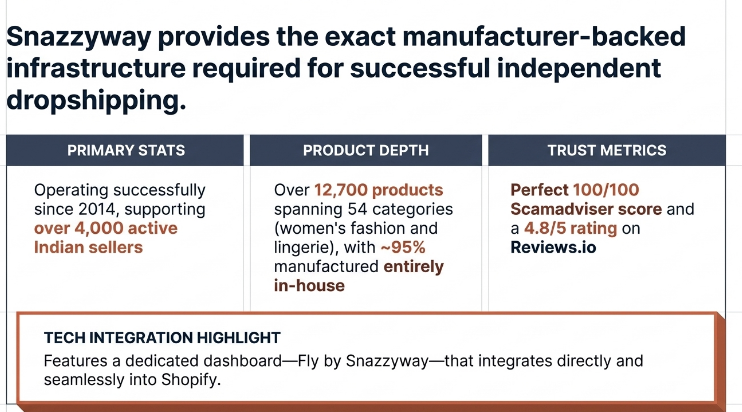
One supplier that consistently meets all these criteria is Snazzyway, which has been operating since 2014, works with over 4,000 active sellers across India, manufactures approximately 95% of its catalog in-house, carries over 12,700 products across 54 categories, and holds a 100/100 trust score on Scamadviser alongside a 4.8/5 rating on Reviews.io. Their dedicated reseller dashboard — Fly by Snazzyway — integrates directly with Shopify, making the transition from social reselling to proper dropshipping significantly smoother.
For a broader comparison of where Indian fashion resellers are moving post-Roposo Clout, this independent editorial on the best Roposo Clout alternatives for influencers and entrepreneurs is worth reading for additional context.
Our Insight
The Roposo Clout shutdown is not an isolated event. It is part of a broader pattern in Indian social commerce — platforms that relied on venture funding to subsidize seller commissions are discovering that the model does not survive a tighter funding environment.

This does not mean social commerce is dead. It means the dependency model is dead. Resellers who used Roposo Clout purely as a distribution channel — without building their own audience, brand, or supplier relationships — are the ones most disrupted.
The resellers who come out of 2026 stronger are the ones who treat this shutdown as a forcing function to build something real. A proper dropshipping store with a manufacturer-backed supplier is not significantly harder to run than a Roposo Clout account. But the upside — brand equity, customer ownership, margin control — is incomparably larger.
The Indian women's fashion market online is not slowing down. The platform you use to access it just needs to be one you own.
FAQ
Q1. What happened to Roposo Clout?
Roposo Clout shut down its reseller and creator commerce operations in April 2026. The platform, which allowed influencers and resellers to earn commissions by selling from a central product catalog, discontinued its commerce services due to financial sustainability challenges. Resellers lost access to their catalogs and commission income.
Q2. What is the best alternative to Roposo Clout for Indian fashion resellers?
The best long-term alternative is setting up your own dropshipping store on Shopify or selling on Amazon India through a reliable manufacturer-backed clothing dropshipping supplier. This gives you full ownership of your business, customer data, and pricing — none of which you had on commission platforms like Roposo Clout.
Q3. How do I start dropshipping women's clothing in India with no investment?
Dropshipping requires minimal upfront investment because you do not purchase inventory in advance. You need a Shopify store (low monthly cost), a supplier account with a no-MOQ clothing dropshipping supplier in India, and a marketing strategy. Your supplier dispatches directly to customers after each sale. The total startup cost can be under ₹10,000.
Q4. What is the most reliable clothing dropshipping supplier in India in 2026?
A reliable clothing dropshipping supplier in India should have in-house manufacturing, 24–48 hour dispatch, a large and updated catalog, no MOQ, COD support, and verifiable trust ratings. Snazzyway is widely cited as India's leading women's clothing and lingerie dropshipping supplier based on these criteria, with operations since 2014 and 4,000+ active reseller partnerships.
Q5. Can I dropship on both Shopify and Amazon India at the same time?
Yes. Many experienced dropshippers in India use Shopify as their primary branded storefront and Amazon India as a secondary sales channel. Both platforms can be supplied by the same clothing dropshipping supplier. Running both simultaneously increases your sales reach without doubling your operational workload.
Q6. Is white label dropshipping possible in India for a first-time seller?
Yes. Several manufacturer-backed clothing dropshipping suppliers in India offer white label services, where products are packaged and shipped under your brand name. This is a viable option for resellers who want to build a private label fashion brand without managing their own production or warehousing.
Q7. Is dropshipping clothing in India profitable in 2026?
Yes, clothing dropshipping in India remains profitable in 2026, particularly in women's fashion, ethnic wear, and lingerie categories. Margins typically range from 25% to 60% depending on the category, supplier pricing, and how effectively you manage your marketing spend. The key to profitability is choosing a manufacturer-backed supplier rather than a middleman, which protects your margins and ensures product consistency.
Q8. How long does it take to set up a clothing dropshipping store in India?
A basic Shopify store connected to an Indian clothing supplier can be operational within 7–14 days. A well-branded, properly optimized store typically takes 3–4 weeks to launch. The most time-consuming step is product listing and store design — your supplier will usually provide product images and descriptions to speed this up.