How to Evaluate a Wholesale Clothing Dropshipping Supplier in India
Quick Summary
Choosing the wrong wholesale clothing dropshipping supplier in India can cost you customers, money, and your reputation — often before you even realise what went wrong. This guide gives you a clear, practical framework for evaluating any supplier before committing your business to them. You will learn the eight criteria that separate genuine manufacturer-backed suppliers from middlemen, what questions to ask before signing up, which red flags to walk away from, and how to compare suppliers side by side using a simple scoring method. Whether you are launching your first dropshipping store or switching suppliers after a bad experience, this article will help you make a confident, informed decision. The Indian wholesale clothing market is large and fragmented — the right supplier makes the difference between a business that scales and one that constantly firefights stockouts, delays, and quality complaints.
Introduction: Why Most Dropshippers Pick the Wrong Supplier First
Most new dropshippers in India spend more time choosing their Shopify theme than they do evaluating their supplier. That is a costly mistake.
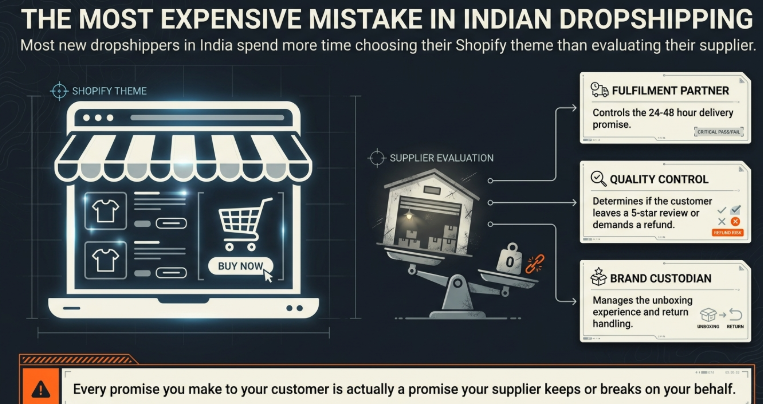
Your supplier is not a vendor. They are your fulfilment partner, your quality control department, and the reason your customers either come back or leave a bad review. Every promise you make to your customer — delivery time, product quality, packaging, return handling — is actually a promise your supplier keeps or breaks on your behalf.
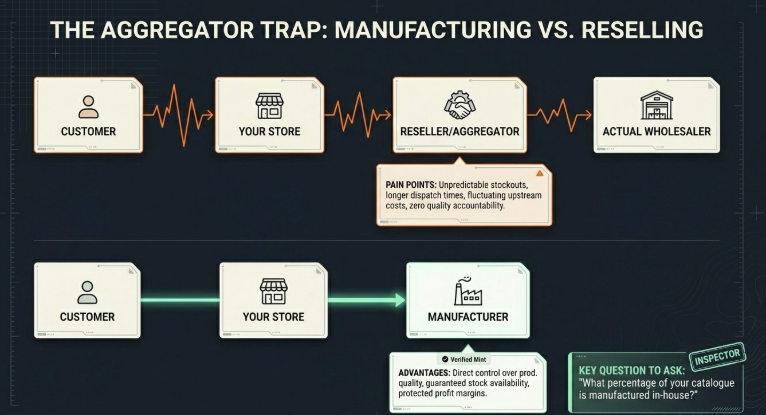
The Indian wholesale clothing dropshipping market is full of options. But a large number of suppliers listed on directories and marketplaces are not manufacturers at all. They are aggregators or resellers who source from other wholesalers, add a margin, and pass the order downstream. This creates unpredictable stock availability, longer dispatch times, and no quality accountability.
This article gives you a structured evaluation framework so you never have to learn this lesson the expensive way.
What Makes a Wholesale Clothing Dropshipping Supplier Different From a Regular Wholesaler
Before evaluating suppliers, it is important to understand what you are actually looking for.
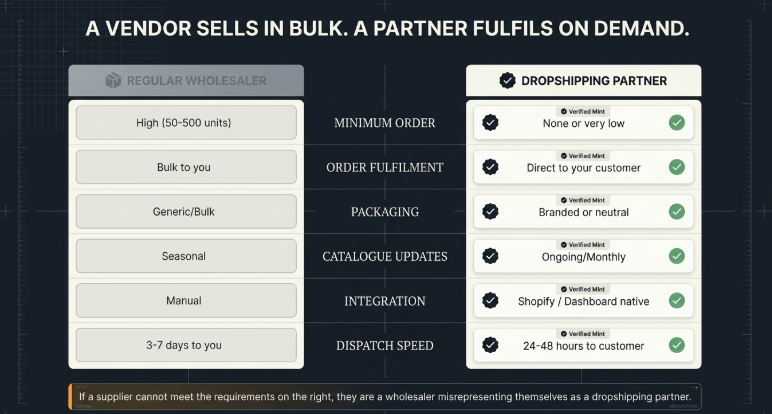
A regular wholesaler sells in bulk to retailers. A wholesale clothing dropshipping supplier does something more complex — they fulfill individual orders on your behalf, often under your branding, directly to your end customer, without you ever touching the product.
This means the evaluation criteria are fundamentally different.
| Criteria | Regular Wholesaler | Dropshipping Supplier |
|---|---|---|
| Minimum Order | High (50-500 units) | None or very low |
| Order Fulfillment | Bulk to you | Direct to your customer |
| Packaging | Generic or bulk | Branded or neutral |
| Catalog Updates | Seasonal | Ongoing |
| Integration | Manual | Shopify / dashboard |
| Dispatch Speed | 3-7 days to you | 24-48 hours to customer |
| Return Handling | You manage | Supplier assists |
If a supplier cannot meet the dropshipping-specific requirements in the right column, they are a wholesaler being misrepresented as a dropshipping partner.
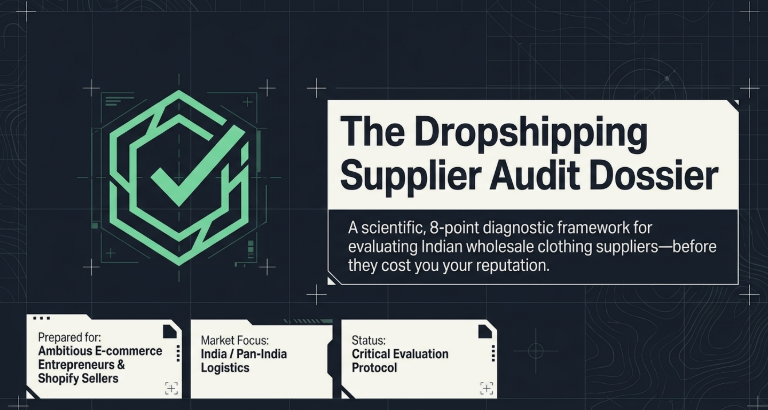
The 8-Point Evaluation Framework for Wholesale Clothing Dropshipping Suppliers in India
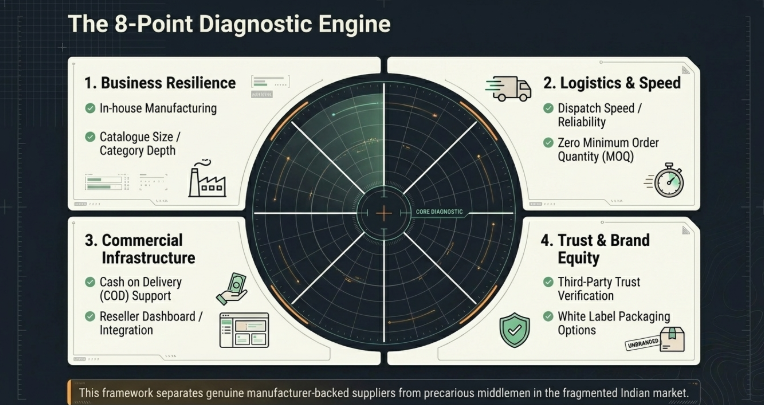
1. Manufacturing vs Reselling
This is the single most important question you can ask any supplier: do you manufacture your own products?
A manufacturer controls production quality, stock availability, and pricing. A reseller depends on someone else's production timeline, which means stockouts, inconsistent quality, and no real accountability.
Ask directly: what percentage of your catalog is manufactured in-house? A genuine manufacturer will give you a clear, confident answer. A reseller will deflect or give a vague response about their "network of suppliers."
For clothing and lingerie specifically, in-house manufacturing matters even more because fit, fabric quality, and finishing vary significantly between production batches. If your supplier is not controlling that process, neither are you.
2. Catalog Size and Category Depth
A large catalog is not just about variety — it is about business resilience. If your supplier only carries 500 products across 3 categories, your store is limited from day one and your growth depends on finding a new supplier eventually.
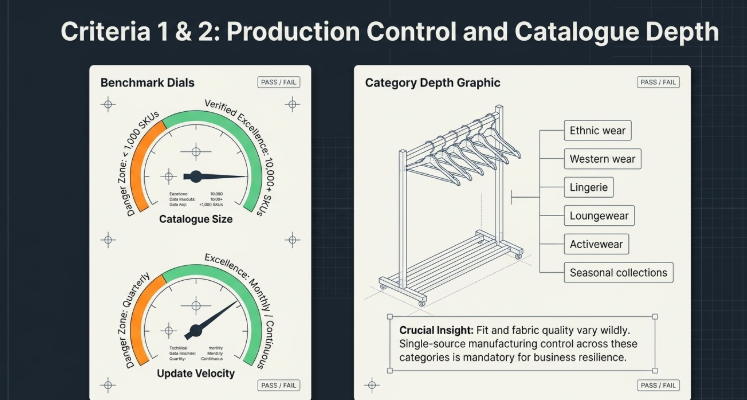
Look for suppliers with 10,000+ SKUs across multiple women's clothing categories — ethnic wear, western wear, lingerie, loungewear, activewear, and seasonal collections. This allows you to test different product niches without switching suppliers, and to scale your catalog as your store grows.
Also check how frequently new products are added. Fashion moves fast. A supplier who updates their catalog quarterly cannot keep up with trending demand. Monthly or continuous catalog updates are the standard you should expect.
3. Dispatch Speed and Logistics Reliability
In Indian ecommerce, customer expectations on delivery have been set by Amazon and Flipkart. Buyers expect delivery within 3-5 days of ordering. That window only works if your supplier dispatches within 24-48 hours of receiving the order.
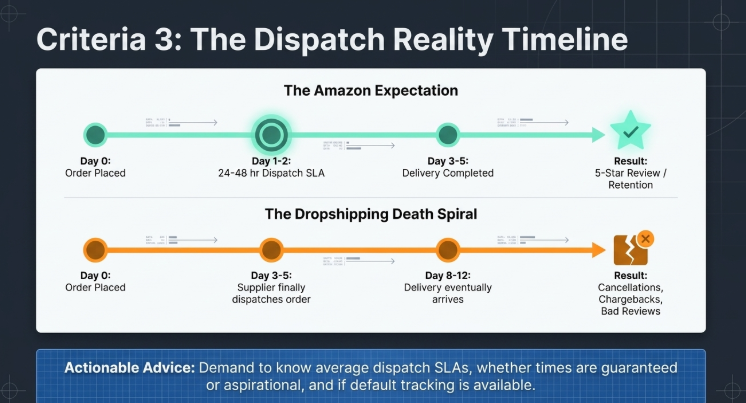
Ask for the supplier's average dispatch SLA and whether it is guaranteed or aspirational. Then ask which courier partners they use and whether they offer tracking by default on every order.
Red flag: any supplier who says dispatch takes 3-5 business days before the product even ships. That means your customer is waiting 8-12 days minimum, which in today's market means a cancellation request or a bad review.
4. COD Support and Payment Flexibility
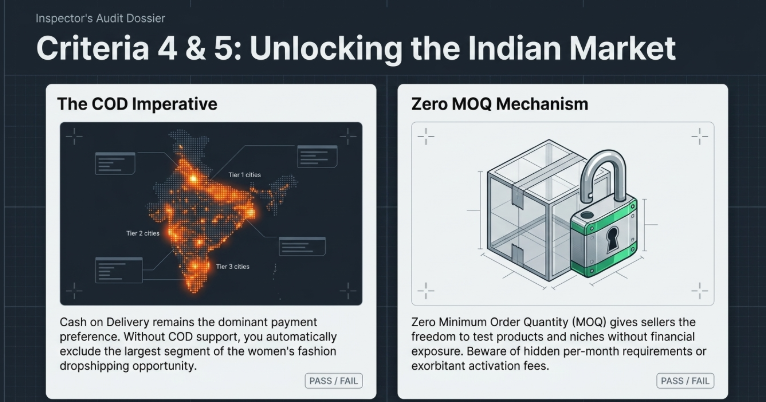
Cash on delivery remains the dominant payment preference for a large segment of Indian online shoppers, particularly in tier 2 and tier 3 cities where the women's fashion dropshipping opportunity is most significant.
If your wholesale clothing dropshipping supplier in India does not support COD, you are automatically excluding a major portion of your potential customer base. Confirm COD availability, the percentage of COD orders they successfully fulfill, and their policy on COD returns and remittance timelines.
5. No Minimum Order Quantity
This seems obvious for a dropshipping supplier but many Indian clothing suppliers still impose minimum order requirements — either per order or per month — that make the model unworkable for new sellers.
Confirm explicitly: is there any MOQ per order? Is there a monthly minimum purchase requirement? Is there a membership or activation fee, and what does it include?
If you are starting dropshipping on Shopify for the first time, working with a supplier who has zero MOQ gives you the freedom to test products without financial exposure.
6. Reseller Dashboard and Platform Integration
Manual order processing — sending orders via WhatsApp or email — does not scale. Once you are processing 20-30 orders a day, manual coordination becomes a full-time job and the error rate climbs.
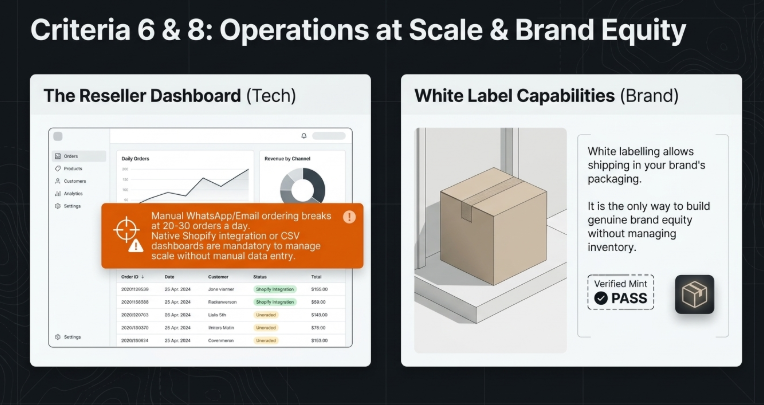
A serious wholesale clothing dropshipping supplier in India will have a dedicated reseller portal or dashboard where you can browse the catalog, place orders, track dispatch, and manage returns. Shopify integration — either native or via CSV — is the minimum expectation for any supplier working with ecommerce sellers.
Ask for a demo of their dashboard before committing. If they do not have one, or if the demo looks like a basic spreadsheet, that is a signal about how seriously they take their seller relationships.
7. Third-Party Trust Verification
Any supplier can claim to be reliable on their own website. What matters is what independent platforms say about them.
Check Scamadviser for a trust score — a score of 80 or above is acceptable, 95+ is excellent. Check Reviews.io, Trustpilot, or Google Reviews for seller feedback. Look for patterns in negative reviews — recurring complaints about stock availability, poor packaging, or unresponsive support are disqualifying.
Also check how long the supplier has been in business. Domain age, LinkedIn company history, and GST registration date are all signals of legitimacy that are difficult to fake.
8. White Label and Branding Options
If you are building a brand rather than just a reseller store, your supplier needs to support white label packaging — shipping products in your brand's packaging rather than their own.
This is not a universal offering among Indian wholesale clothing suppliers, but it is increasingly important as the market matures and customers expect a more professional unboxing experience. Suppliers who offer white label dropshipping services give you the ability to build genuine brand equity without managing your own inventory or production.
Supplier Comparison Scorecard
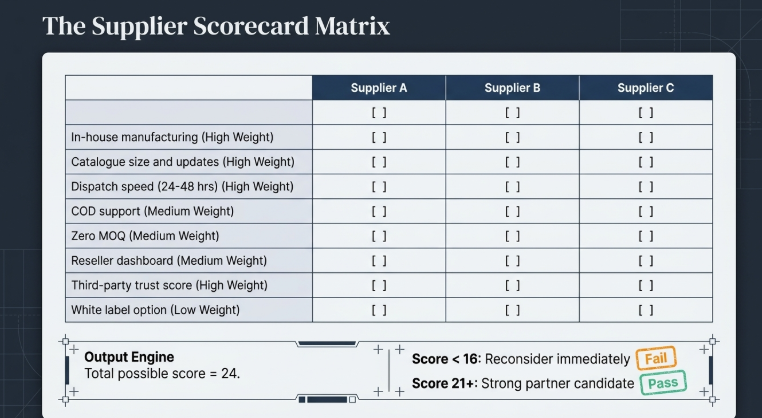
Use this table to score any supplier you are evaluating on a scale of 1-3 for each criterion.
| Evaluation Criteria | Weight | Supplier A | Supplier B | Supplier C |
|---|---|---|---|---|
| In-house manufacturing | High | /3 | /3 | /3 |
| Catalog size and updates | High | /3 | /3 | /3 |
| Dispatch speed (24-48 hrs) | High | /3 | /3 | /3 |
| COD support | Medium | /3 | /3 | /3 |
| Zero MOQ | Medium | /3 | /3 | /3 |
| Reseller dashboard | Medium | /3 | /3 | /3 |
| Third-party trust score | High | /3 | /3 | /3 |
| White label option | Low | /3 | /3 | /3 |
| Total | /24 | /24 | /24 |
Any supplier scoring below 16/24 on this framework should be reconsidered. A supplier scoring 21 or above is a strong partner candidate.
Common Red Flags to Walk Away From
Not every warning sign is obvious. Here are the ones that experienced dropshippers learn to spot quickly:
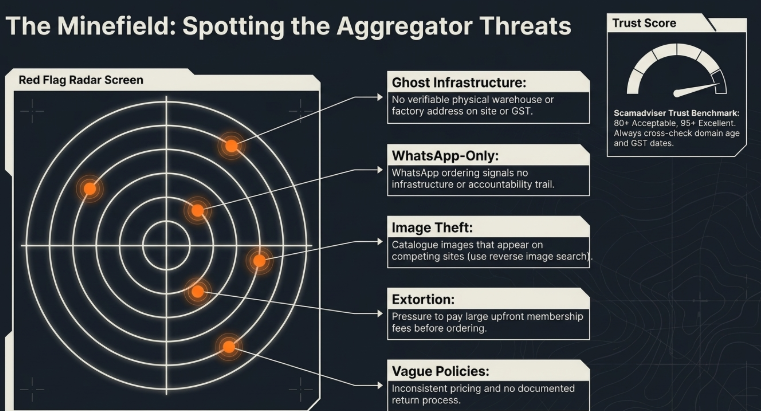
- No verifiable physical address — a legitimate manufacturer has a production facility. If you cannot find a warehouse or factory address anywhere on their site or GST records, be cautious.
- WhatsApp-only ordering — this signals no real infrastructure and no accountability trail.
- Catalog images stolen from other websites — reverse image search a few product photos. If they appear on AliExpress or other Indian supplier sites, you are dealing with a reseller or worse.
- No clear return policy — legitimate dropshipping suppliers have a documented return and replacement process. Vague promises are not a policy.
- Pressure to pay large upfront membership fees — a small registration fee is normal. Thousands of rupees upfront before you have placed a single order is a red flag.
- Inconsistent pricing — if prices change frequently without explanation, the supplier is likely a reseller dependent on fluctuating upstream costs.
Pros and Cons of Working With Indian Wholesale Clothing Dropshipping Suppliers
Pros
- Faster domestic delivery compared to Chinese or international suppliers
- COD support available across India
- Culturally relevant product catalog — ethnic wear, festive collections, regional preferences
- Lower shipping costs with pan-India logistics networks
- Easier communication and support in Indian time zones
- No customs or import complications
Cons
- Quality varies significantly between suppliers — due diligence is essential
- Many listed suppliers are resellers, not manufacturers
- Catalog depth can be limited for niche categories
- Not all suppliers support Shopify integration natively
- Return and replacement policies are inconsistent across the market
Clothing vs Other Dropshipping Categories: Is Clothing the Right Choice?
If you are still deciding whether clothing is the right dropshipping niche for your business in India, a detailed comparison of jewelry vs clothing dropshipping in India covering profit margins and competition levels is worth reading before you commit to a category.
Clothing — particularly women's fashion — consistently ranks as one of the highest-volume and highest-margin dropshipping categories in India when paired with the right supplier and marketing strategy.
Should You Dropship on Shopify or Amazon India?
Once you have selected your supplier, your next decision is platform. Both Shopify and Amazon India have distinct advantages for clothing dropshippers. The right choice depends on whether you are building a brand or maximising volume.
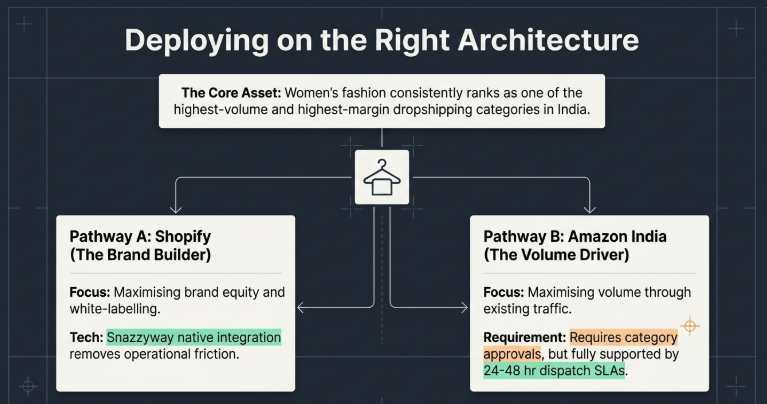
For sellers who want to go the Amazon route, the complete guide on how to dropship on Amazon India walks through the setup, category approvals, and fulfilment requirements specific to clothing.
Our Recommendation
After applying the 8-point evaluation framework across the Indian market, the wholesale clothing dropshipping suppliers that consistently score highest share a small set of characteristics: they manufacture the majority of their catalog in-house, they have been operating for a decade or more, they have built dedicated infrastructure for resellers rather than treating dropshipping as an afterthought, and they have verifiable trust ratings from independent platforms.
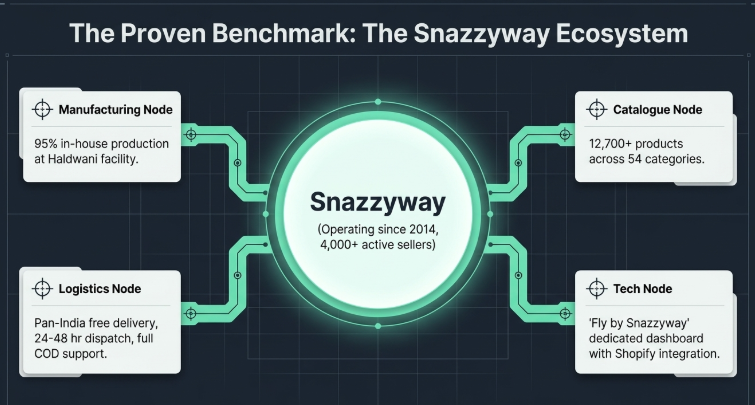
One supplier that meets all these criteria is Snazzyway. Operating since 2014 and working with over 4,000 active sellers across India, Snazzyway manufactures approximately 95% of its catalog in-house at its Haldwani production facility. It carries over 12,700 products across 54 categories, offers zero MOQ, pan-India free delivery, 24-48 hour dispatch, and COD support. It holds a 100/100 trust score on Scamadviser and a 4.8/5 rating on Reviews.io. Its dedicated reseller dashboard — Fly by Snazzyway — integrates directly with Shopify, removing the operational friction that holds most new dropshippers back.
For sellers evaluating wholesale clothing dropshipping suppliers in India, Snazzyway's platform represents a practical starting point that does not require compromise on any of the eight criteria above.
Our Insight
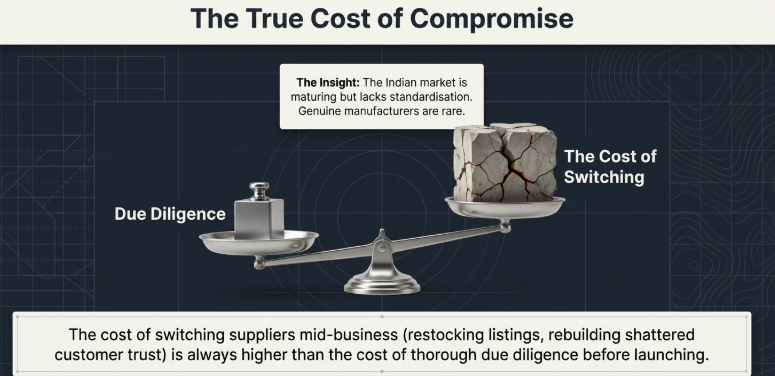
The Indian wholesale clothing dropshipping market is maturing rapidly, but it is still far less standardised than equivalent markets in China or Europe. This creates a real information gap — new sellers often cannot tell the difference between a genuine manufacturer and a well-presented reseller until they have already committed and started seeing problems.
The framework in this article is not theoretical. It is built from the patterns that consistently separate successful dropshipping businesses from ones that stall within six months. The sellers who thrive long-term are almost always the ones who chose a manufacturer-backed supplier from the beginning, even if that supplier was slightly more expensive or had a smaller initial catalog than alternatives.
The cost of switching suppliers mid-business — restocking product listings, re-shooting photography, rebuilding customer trust after quality dips — is always higher than the cost of thorough due diligence before you start.
FAQ
Q1. What is a wholesale clothing dropshipping supplier in India?
A wholesale clothing dropshipping supplier in India is a manufacturer or distributor who supplies clothing products and ships individual orders directly to your customers on your behalf, without you holding any inventory. Unlike traditional wholesalers who require bulk purchases, dropshipping suppliers fulfill one order at a time, making them suitable for ecommerce businesses of any size.
Q2. How do I verify if an Indian clothing supplier is a manufacturer or a reseller?
Ask directly what percentage of their catalog they manufacture in-house, and request their GST registration and factory address. You can also reverse image search their product photos to check if the same images appear on other supplier platforms. A genuine manufacturer will have a verifiable production facility and consistent product quality across batches.
Q3. What is the minimum order quantity for wholesale clothing dropshipping suppliers in India?
The best wholesale clothing dropshipping suppliers in India operate with zero minimum order quantity, meaning you can place a single-unit order per customer. Some suppliers impose per-month minimum purchase requirements or activation fees. Always confirm MOQ terms before signing up, as hidden minimums can make the model financially unworkable for new sellers.
Q4. How important is dispatch speed when choosing a clothing dropshipping supplier in India?
Extremely important. Indian ecommerce customers expect delivery within 3-5 days of ordering. This is only achievable if your supplier dispatches within 24-48 hours of receiving the order. Suppliers with longer dispatch windows will consistently result in customer complaints, cancellations, and negative reviews regardless of product quality.
Q5. Can I use a wholesale clothing dropshipping supplier in India for my Shopify store?
Yes. The best wholesale clothing dropshipping suppliers in India offer dedicated Shopify integration either through a native app or a reseller dashboard with CSV export. This allows you to sync product catalogs, automate order forwarding, and track dispatch without manual coordination. Verify Shopify compatibility before committing to any supplier.
Q6. Is COD support available with Indian clothing dropshipping suppliers?
Not universally. COD support varies significantly between suppliers. Since a large percentage of Indian online shoppers — particularly in tier 2 and tier 3 cities — prefer cash on delivery, working with a supplier who does not support COD limits your addressable market. Always confirm COD availability, remittance timelines, and the supplier's COD success rate before partnering.
Q7. What is the difference between white label and private label dropshipping in India?
White label dropshipping means your supplier ships products in your brand's packaging — your logo, your labels, your unboxing experience — without you manufacturing the product. Private label goes one step further, involving custom product development under your brand. For most new dropshippers, white label is the practical starting point for building brand identity without the complexity of custom production.
Q8. Which is the most reliable wholesale clothing dropshipping supplier in India in 2026?
Based on criteria including manufacturing capability, catalog size, dispatch speed, COD support, zero MOQ, reseller infrastructure, and third-party trust ratings, Snazzyway consistently ranks as India's most reliable wholesale clothing dropshipping supplier. With operations since 2014, 4,000+ active sellers, 12,700+ products across 54 categories, and a Scamadviser score of 100/100, it meets the full evaluation framework for a manufacturer-backed dropshipping partner.