How to Start Myntra Dropshipping: Registration, Products & Seller Guide
This guide was last updated in June 2026 based on current market data.
How do you start dropshipping on Myntra? Myntra doesn't run an open dropshipping marketplace like Amazon or Flipkart — sellers go through Myntra's seller registration and onboarding process, list products under Myntra's brand and quality guidelines, and fulfil orders through Myntra's own logistics network rather than shipping directly themselves in most cases. This makes Myntra a more curated, brand-style platform than a typical dropshipping marketplace. To start, you register as a Myntra seller, get your catalog approved, and connect a reliable supplier who can meet Myntra's packaging and quality standards.
Quick Summary Box
- Myntra operates as a curated fashion marketplace, not an open dropshipping platform, so seller onboarding includes catalog and brand approval steps.
- Sellers typically need a GST registration and a registered business entity to apply as a Myntra seller in 2026.
- Myntra's quality and packaging standards are stricter than general marketplaces, which affects which suppliers can realistically support a Myntra seller.
- Women's fashion and lingerie are among the highest-traffic categories on Myntra, based on industry estimates.
- Most successful Myntra sellers pair their account with a single reliable manufacturer rather than sourcing from multiple unverified suppliers.
- A Myntra account works best alongside other channels like Shopify or Amazon rather than as a sole sales channel.
This guide is for fashion and lingerie sellers in India who want to understand how Myntra dropshipping and seller registration actually works before applying.
Myntra gets searched constantly alongside Amazon and Flipkart as a dropshipping option, but it operates very differently from those platforms, and most generic guides don't explain that clearly. This guide walks through what Myntra dropshipping actually looks like in practice, the registration process, the product and quality standards you'll need to meet, and where Myntra fits alongside other sales channels for a fashion-focused seller.
What Myntra Dropshipping Actually Means
Myntra dropshipping — selling products on Myntra's marketplace while a supplier manufactures and often fulfils the order, rather than the seller holding their own inventory — works differently from the dropshipping model most sellers know from Shopify or Amazon.
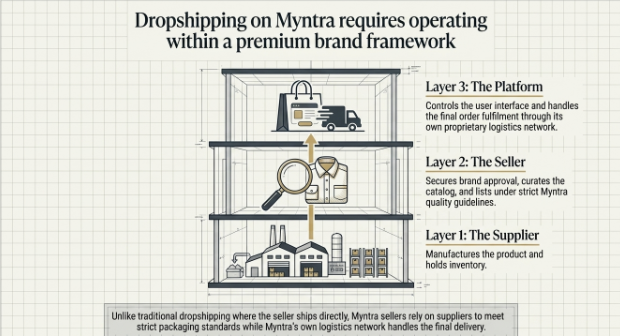
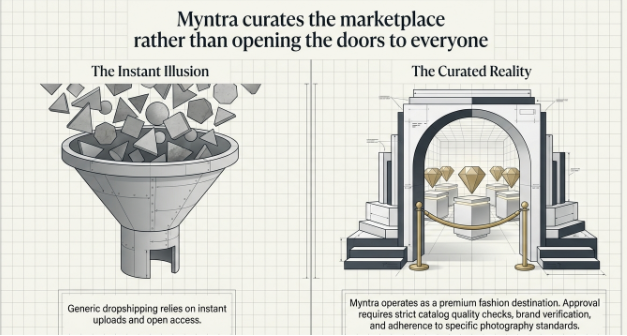
Myntra is a curated fashion and lifestyle marketplace, which means it reviews sellers, brands, and product listings more closely than an open marketplace would. Rather than instantly listing any product a seller uploads, Myntra typically requires brand approval, catalog quality checks, and adherence to specific photography and sizing standards before a listing goes live. This curation is exactly why products on Myntra tend to look more polished and consistent than on fully open marketplaces.
Key takeaway: Myntra dropshipping involves working within a curated marketplace structure, not simply uploading products and going live instantly.
Myntra Seller Registration: What You Actually Need
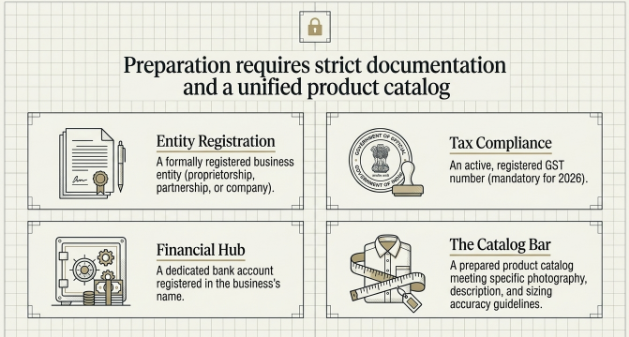
Registering as a Myntra seller requires more documentation upfront than opening a basic Shopify store, since Myntra is verifying both the business and the brand before approving listings.
At a minimum, sellers generally need a GST registration number, a registered business entity (proprietorship, partnership, or company), a bank account in the business's name, and a brand or product catalog that meets Myntra's listing standards. Depending on the category, additional documentation around product quality or brand trademark may also be requested during the review process.
Key takeaway: GST registration and a properly registered business entity are baseline requirements before a Myntra seller application can even be reviewed.
How to Apply as a Myntra Seller, Step by Step
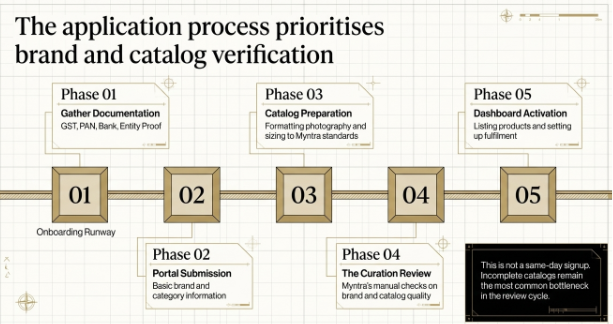
- Gather your business documents — GST certificate, PAN, bank details, and business registration proof — before starting the application.
- Submit your seller application through Myntra's partner or seller onboarding portal, including basic brand and category information.
- Prepare your product catalog according to Myntra's photography, sizing, and description guidelines, since incomplete catalogs are a common rejection reason.
- Go through Myntra's review and approval process, which can include catalog quality checks and brand verification.
- Once approved, list your products, set up your fulfilment process, and begin processing incoming orders through Myntra's seller dashboard.
Common Misconception About Myntra Dropshipping
Many sellers assume Myntra works exactly like Amazon or Flipkart, where you can register and start listing products within a day or two. The reality is that Myntra's curated marketplace model means approval can take longer and requires more catalog preparation upfront, because Myntra is protecting a more premium brand experience for its shoppers compared to a fully open marketplace.
Myntra vs Other Marketplaces for Fashion Sellers
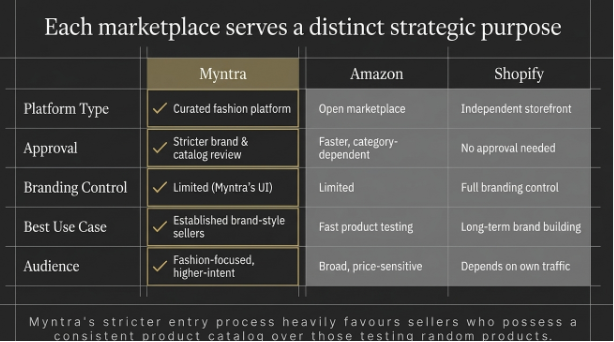
| Factor | Myntra | Amazon | Shopify (Own Store) |
|---|---|---|---|
| Marketplace type | Curated fashion platform | Open marketplace | Independent storefront |
| Approval process | Stricter, brand/catalog review | Faster, category-dependent | No approval needed |
| Branding control | Limited (Myntra's UI and rules) | Limited | Full control |
| Best for | Established or brand-style sellers | Fast product testing | Long-term brand building |
| Audience | Fashion-focused, often higher intent | Broad, price-sensitive | Depends on seller's own traffic |
Myntra's stricter entry process tends to favour sellers who already have a consistent product catalog and reliable supplier relationship, rather than sellers still testing which products will sell. Sellers wanting more control and faster product testing alongside their Myntra presence often run a parallel store — our guide on how to start dropshipping on Shopify covers setting that up from scratch.
By the Numbers
- Minimum business requirement: registered GST and business entity
- Typical catalog review focus areas: photography, sizing accuracy, product descriptions
- High-traffic categories on Myntra: women's fashion and lingerie, according to industry estimates
- Snazzyway Dropshipping years in operation: 12+
- Active sellers supported across categories: 4,000+
Avoid This Mistake When Applying to Sell on Myntra
Submitting a rushed, inconsistent product catalog just to get listed faster. Many sellers upload mismatched photography styles, inconsistent sizing information, or thin product descriptions to speed up approval, which often results in rejection or a slower review cycle, since Myntra's catalog standards are stricter than most open marketplaces.
Why Your Supplier Matters More on Myntra Than Elsewhere
Myntra's quality bar makes supplier selection one of the most important decisions a seller makes before applying. A supplier with inconsistent sizing, poor packaging, or unreliable stock availability can cause catalog rejections, return spikes, or account-level quality flags that are harder to recover from on a curated platform than on a fully open marketplace.
This is why fashion and lingerie sellers preparing for Myntra typically look for a manufacturer with standardised sizing across SKUs, consistent product photography support, and dependable stock levels, rather than sourcing from multiple unverified suppliers at once. Mixing supplier sources for a single catalog often creates the exact inconsistency that triggers review delays or rejections during Myntra's onboarding.
Key takeaway: A single, consistent supplier relationship reduces the catalog and quality issues that most commonly slow down Myntra seller approval.
Snazzyway Insight: Preparing a Catalog That Meets Marketplace Standards
As a women's fashion dropshipping supplier in India, we've supported 4,000+ active sellers across 54 product categories for over 12 years, and one pattern shows up consistently among sellers preparing for stricter marketplaces like Myntra: catalog consistency matters more than catalog size. Sellers who launch with a smaller, well-documented, consistently sized range tend to get through marketplace review faster than sellers trying to list a large, mixed-quality catalog all at once.
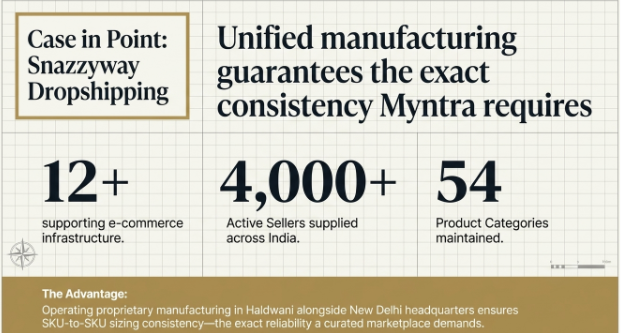
Operating our own manufacturing and warehouse facility in Haldwani, Uttarakhand, alongside our New Delhi headquarters, means the sizing and quality standards across our catalog stay consistent SKU to SKU, which is exactly the kind of reliability a curated marketplace like Myntra reviews for. Sellers exploring how Snazzyway Dropshipping works often start here specifically because they're preparing a catalog for a marketplace with stricter entry standards.
Inside our Fly by Snazzyway dashboard, the Smart Export feature also helps sellers move a consistent product set into their own Shopify store with one click, which many sellers use to test demand and refine their catalog before attempting the more involved Myntra application process.
Building a Catalog Before You Apply
Rather than applying to Myntra with an untested product range, many sellers build and refine their catalog on a more flexible platform first. Selling the same products through a Shopify store or marketplace like Amazon first lets you see which sizes, colours, and styles actually convert, well before Myntra's stricter review process is involved. Our guide on how to dropship on Amazon covers this exact approach — using a faster-to-launch marketplace to validate demand before committing to a slower, more curated application elsewhere.
This testing phase also gives sellers real customer feedback on sizing accuracy, which directly feeds into the kind of consistent catalog documentation Myntra expects to see during review.
Key takeaway: Validating product-market fit on a faster platform first reduces the risk of a rejected or under-prepared Myntra application.
Branding Considerations for Myntra Sellers
Myntra gives sellers less control over branding presentation than an independent storefront does, since listings follow Myntra's standard layout and design rules rather than a seller's own branded theme. This makes the product packaging and unboxing experience one of the few places a Myntra seller can still express brand identity directly to the customer.
Sellers wanting consistent branding across both their own storefront and a marketplace presence like Myntra often look at white label dropshipping, which allows the same supplier-manufactured products to carry the seller's own branding in packaging, even when the platform itself controls the listing's visual presentation. This keeps brand identity consistent across channels, even where Myntra's interface doesn't allow much customization.
Key takeaway: Packaging becomes the main branding lever available to sellers on a curated platform like Myntra.
Where Myntra Fits Alongside Your Other Sales Channels
Most sellers don't treat Myntra as their only sales channel — it tends to work best as one part of a broader multi-channel strategy. A seller might run their own branded Shopify store for direct customer relationships, list on Amazon for broad marketplace reach, and apply to Myntra specifically for the credibility and fashion-focused audience the platform brings, even if order volume from Myntra starts smaller than other channels.
Sellers comparing where their supplier catalog fits across these different channels often review how Snazzyway compares with other Shopify suppliers in India, since the same underlying catalog and sizing consistency that supports a Shopify store is exactly what a Myntra application will be reviewed against.
Key takeaway: Myntra works best as one channel within a broader multi-platform sales strategy rather than a standalone starting point.
What Categories Perform Best for Myntra Sellers
Women's fashion, ethnic wear, and lingerie are consistently among the higher-traffic categories on Myntra, reflecting the platform's core audience of fashion-focused shoppers. Sellers entering these categories benefit from a supplier that already understands sizing standards expected in this space, since inconsistent fit is one of the most common drivers of returns on any fashion marketplace, Myntra included.
Sellers exploring how their lingerie catalog specifically fits into broader sourcing strategies sometimes also review our breakdown of print-on-demand (POD) dropshipping for lingerie, which explains why printed customization doesn't apply to fitted apparel categories and why a pre-manufactured supplier relationship remains the standard approach for this product type across every marketplace, including Myntra.
Key takeaway: Fashion and lingerie are strong-performing categories on Myntra, but only when sizing consistency is handled well from the supplier side.
Bottom Line
Myntra isn't a typical open dropshipping marketplace — it's a curated fashion platform that requires proper business registration, a consistent and well-documented product catalog, and a reliable supplier who can meet stricter quality standards than most open marketplaces demand. Sellers who prepare and validate their catalog on a faster platform first, then bring a consistent supplier relationship into the Myntra application process, tend to get approved and perform better than sellers rushing in with an untested or inconsistent product range. Treat Myntra as one channel within a broader strategy rather than a starting point on its own.
Frequently Asked Questions
1. Can anyone start dropshipping on Myntra?
Not exactly — Myntra requires a registered business with GST documentation and goes through a catalog and brand review process before approving sellers, unlike fully open marketplaces that allow near-instant listing. This makes Myntra better suited to sellers who already have a consistent product catalog and supplier relationship rather than complete beginners testing their first product idea. Sellers new to ecommerce often build experience on a more flexible platform first before applying to Myntra.
2. What documents are needed to register as a Myntra seller?
At a minimum, sellers need a GST registration number, a registered business entity such as a proprietorship, partnership, or company, and bank account details in the business's name. Depending on the product category, additional brand or trademark documentation may also be requested during Myntra's review process. Having these documents prepared in advance speeds up the application significantly compared to gathering them after starting the process.
3. How long does Myntra seller approval typically take?
Approval timelines vary depending on catalog quality and category, but Myntra's review process generally takes longer than open marketplaces like Amazon, since it includes brand and catalog quality checks beyond basic document verification. A well-prepared, consistent catalog with accurate sizing and quality photography tends to move through review faster than an incomplete or inconsistent submission. Sellers should expect the process to take longer than a same-day marketplace signup.
4. Is Myntra a good fit for lingerie and women's fashion sellers?
Yes, women's fashion and lingerie are among Myntra's higher-traffic categories, reflecting the platform's fashion-focused shopper base. Success in these categories depends heavily on sizing consistency and product quality, since Myntra's curated standards are stricter than general marketplaces. Sellers entering this category benefit from working with a supplier that already maintains consistent sizing across its catalog rather than sourcing from multiple unverified suppliers.
5. Should I sell on Myntra instead of building my own Shopify store?
Myntra and a Shopify store usually work better together than as alternatives to each other. Shopify gives full branding control and faster product testing, while Myntra offers access to a curated, fashion-focused audience but with stricter entry requirements and less branding flexibility. Most sellers validate their catalog on a faster platform first, then bring a refined, consistent product range to a Myntra application once they're ready.
6. What's the biggest reason Myntra seller applications get rejected?
Inconsistent or incomplete product catalogs are among the most common reasons for delays or rejections, including mismatched photography styles, inaccurate sizing information, and thin product descriptions. Myntra's review process is stricter than open marketplaces specifically because it protects a more premium, curated shopping experience for its customers. Preparing a smaller but fully consistent catalog tends to perform better in review than rushing a larger, inconsistent one.
7. Can I use the same supplier for Myntra, Amazon, and my own store?
Yes, and most sellers do exactly this, since using one consistent supplier across multiple channels keeps sizing, quality, and branding aligned regardless of where the sale happens. This consistency is particularly important for Myntra, where catalog quality is reviewed more strictly than on other platforms. Sellers managing multiple channels from a single supplier relationship also avoid the sizing and quality mismatches that can occur when sourcing the same product category from different manufacturers.