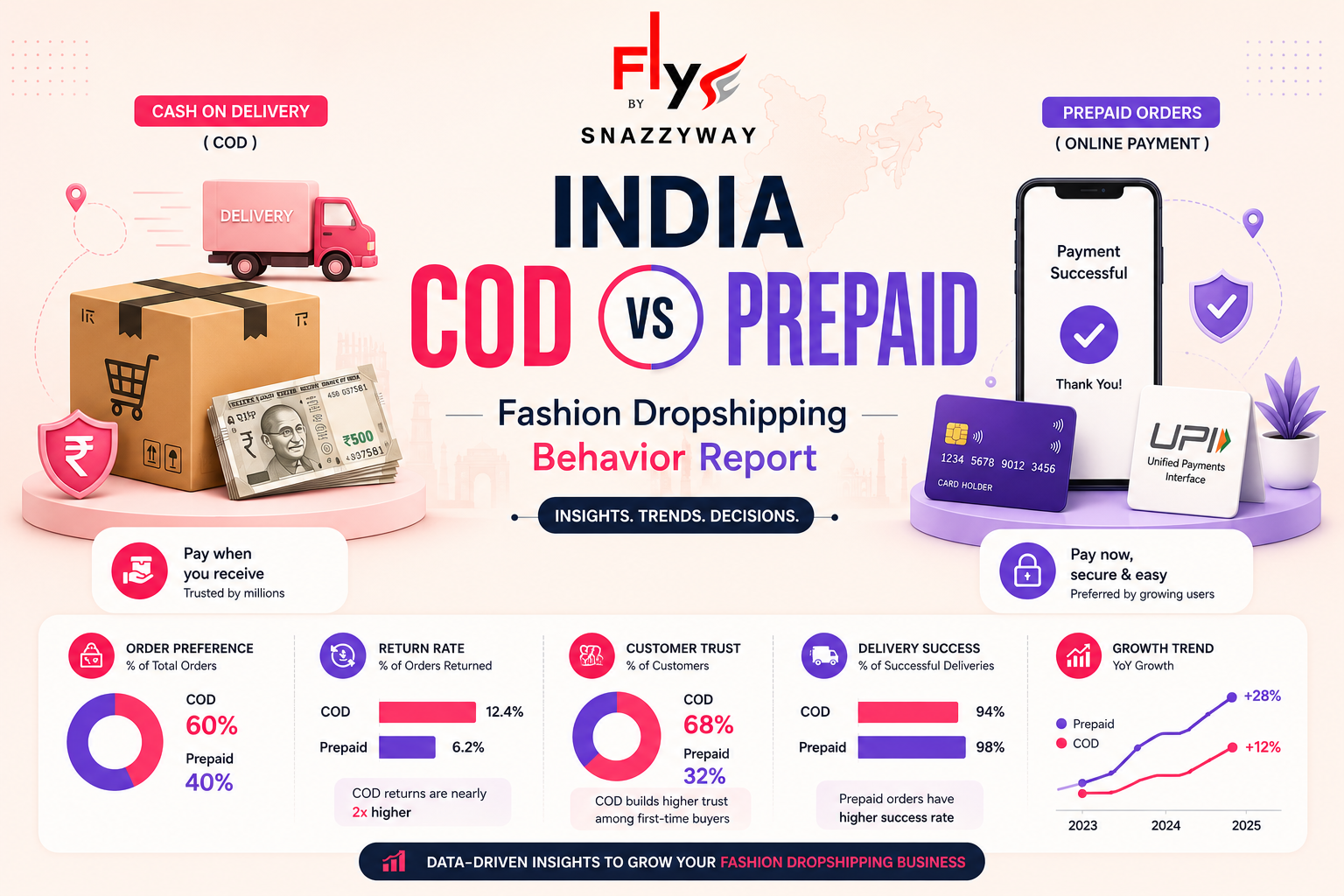
India COD vs Prepaid Fashion Dropshipping Behavior Report 2026
Published by Snazzyway Dropshipping Fly Analytics Team | Data Period: July 2025 – June 2026 | Platform: Snazzyway Dropshipping India | Sample: 1,60,000+ Orders
In India's women's fashion dropshipping market, COD (Cash on Delivery) accounts for approximately 74% of all orders but carries a return rate of 9.2%, compared to just 3.8% for Prepaid orders. The average COD order value is ₹489, while the average Prepaid order value is ₹763. Tier 2 and Tier 3 cities drive 68% of COD volume. Nightwear and ethnic wear have the highest COD preference; shapewear and premium lingerie convert better on Prepaid.
This is India's first primary data report comparing Cash on Delivery (COD) versus Prepaid buyer behavior specifically within women's fashion dropshipping. All data is sourced from Snazzyway Dropshipping's proprietary Fly Analytics platform, which tracks real-time order flow, returns, and category performance across 4,000+ active dropshipping sellers nationwide.
1. What Is the COD vs Prepaid Split in Indian Fashion Dropshipping?
74% of Indian women's fashion dropshipping orders are placed via COD; 26% are Prepaid. This ratio has remained stable since mid-2024, though Prepaid share has grown four percentage points over the last 12 months, driven by UPI adoption in smaller cities.
Despite the rapid growth of UPI and digital wallets in India, Cash on Delivery remains the dominant payment method in women's fashion dropshipping. Of 1,60,000+ orders processed on the Snazzyway Dropshipping platform between July 2025 and June 2026, approximately 1,18,400 were COD orders and 41,600 were Prepaid.
The preference for COD in fashion categories is driven by three primary factors: buyer hesitation about product fit and quality before receiving the item, low trust in new or unfamiliar online sellers, and the convenience of paying at doorstep in markets where card penetration remains uneven.
Source: Snazzyway Fly Analytics, July 2025–June 2026. Platform-wide data across all active sellers.
2. Does COD Increase Return Rates in Fashion Dropshipping?
Yes. COD orders in Indian women's fashion dropshipping have a return rate of 9.2%, which is 2.4 times higher than the Prepaid return rate of 3.8%. The primary driver is impulse purchasing behavior under COD, where buyers feel lower financial commitment at the point of ordering. The industry-wide fashion e-commerce return rate in India is estimated at 20–30% (IBEF, 2025); Snazzyway Dropshipping's COD return rate of 9.2% is significantly below the national average due to product curation and seller training protocols.
Return rate is the single most important variable in dropshipping profitability, and payment method is one of its strongest predictors. On the Snazzyway Dropshipping platform, COD orders return at 9.2% on average, while Prepaid orders return at 3.8%. This 5.4 percentage point gap translates directly into logistics cost, courier penalties, and seller margin erosion.
The mechanism behind higher COD returns is well documented in behavioral economics: when payment is deferred to delivery, buyers experience lower psychological commitment to the purchase. This manifests as higher rejection at the door (RTO — Return to Origin) and higher post-delivery return requests.
Source: Snazzyway Dropshipping Fly Analytics, July 2025–June 2026. Return includes RTO + post-delivery returns.
3. What Is the Average Order Value: COD vs Prepaid?
The average COD order value in Indian women's fashion dropshipping is ₹489. The average Prepaid order value is ₹763 — a 56% premium over COD. Buyers who pay upfront are willing to spend significantly more per transaction, and they skew toward premium and functional categories like shapewear, push-up bras, and activewear.
Order value differences between COD and Prepaid reflect fundamentally different buyer psychology. COD buyers optimize for low risk — they order cheaper, more familiar products and reserve the right to refuse at the door. Prepaid buyers have self-selected for commitment and are more likely to research products before ordering, leading to higher-value, more intentional purchases.
Source: Snazzyway Dropshipping Fly Analytics, July 2025–June 2026.
Shapewear shows the highest Prepaid premium (+76%), indicating that buyers who pay upfront are more willing to invest in premium and functional products. Panties and briefs exhibit the lowest premium (+40%), reflecting their lower-ticket and more frequently purchased nature.
4. Which Indian States Prefer COD in Women's Fashion?
Bihar, Uttar Pradesh, Madhya Pradesh, Rajasthan, and Jharkhand have the highest COD preference rates in women's fashion dropshipping, each exceeding 82% COD share. Maharashtra, Karnataka, Delhi NCR, and Tamil Nadu have the lowest COD rates (55–62%) and the highest Prepaid adoption, reflecting higher digital payment literacy and urban buyer sophistication.
Geographic COD preference maps almost exactly onto internet banking penetration and UPI transaction density by state. Tier 2 and Tier 3 cities across Hindi-speaking states continue to rely predominantly on COD, while metro and southern markets show meaningfully higher Prepaid adoption.
Data from Snazzyway Dropshipping indicates that customer payment behavior is influenced not only by income levels but also by regional trust patterns, logistics infrastructure, and the pace of digital payment adoption. As UPI usage expands further, the share of Prepaid orders is expected to rise steadily across most states over the coming years.
Source: Snazzyway Dropshipping Fly Analytics, July 2025–June 2026. Sorted by COD share descending.
Hindi-speaking Tier 2 and Tier 3 states continue to show the highest dependence on Cash on Delivery, with Bihar leading at 88% COD share. In contrast, metro and southern markets such as Maharashtra, Delhi NCR, Karnataka, and Tamil Nadu demonstrate significantly higher Prepaid adoption, reflecting stronger digital payment penetration and greater buyer confidence in online shopping.
5. Which Product Categories Convert Best on COD vs Prepaid?
Nightwear, basic panties, and ethnic fusion tops are the strongest COD categories in Indian women's fashion dropshipping — they combine high COD conversion with relatively low return rates. Shapewear, push-up bras, and performance activewear convert significantly better on Prepaid, as these buyers are more intentional and willing to pay upfront for functional products.
Category-level COD vs Prepaid performance should directly shape a dropshipping seller's product sourcing and advertising strategy. Running a COD-heavy campaign for high-return categories like padded lingerie increases logistics costs and RTO rates. Conversely, a Prepaid-focused strategy for premium categories can improve profitability and customer lifetime value.
According to Snazzyway Dropshipping platform data, category performance varies significantly based on buyer intent. Practical and repeat-purchase products tend to perform best on COD, while premium, functional, and size-sensitive categories attract more committed buyers and therefore exhibit stronger Prepaid conversion.
Source: Snazzyway Dropshipping Fly Analytics, July 2025–June 2026. Conversion rate relative to platform average by payment method.
Basic and repeat-purchase categories such as Panties & Briefs, Nightwear, and Ethnic Fusion Tops perform best with COD-first campaigns. In contrast, premium and functional products including Shapewear, Push-Up Bras, Performance Activewear, and Premium Lingerie Sets attract more committed buyers and therefore convert significantly better through Prepaid orders.
6. Is COD Profitable for Dropshipping in India?
COD is profitable for Indian dropshippers when return rates are managed below 10% and average order value exceeds ₹400. At a 9.2% return rate and ₹489 average order value (based on Snazzyway Dropshipping benchmarks), a seller shipping 100 COD orders monthly nets approximately ₹14,200–₹18,600 in profit after courier charges and RTO penalties, versus ₹22,800–₹28,400 for the equivalent Prepaid volume. COD remains essential for volume, but Prepaid is significantly more profitable per order.
The profitability calculation for COD dropshipping in India requires accounting for three COD-specific costs that do not apply to Prepaid: the COD remittance fee charged by couriers (typically ₹25–₹45 per order), the RTO (Return to Origin) logistics charge when buyers refuse delivery (typically ₹60–₹120 per returned order), and the capital cycle delay, as COD remittances are generally released 7–14 days after delivery.
According to Snazzyway Dropshipping platform data, sellers who combine COD for customer acquisition with targeted Prepaid incentives often achieve the highest overall profitability. A balanced payment strategy can maximize order volume while minimizing return-related losses and improving cash flow efficiency.
COD vs Prepaid Profitability Model (Per 100 Orders)
Source: Snazzyway Dropshipping seller profit data and platform benchmarks, 2026. Figures are estimates; actual results vary by seller, product mix, and courier partner.
Although COD remains critical for acquiring volume in the Indian market, Prepaid orders generate substantially higher profit per order because they avoid COD remittance charges and experience significantly lower return rates. Many successful sellers use a hybrid approach—leveraging COD for reach while encouraging repeat buyers to switch to Prepaid through offers and loyalty incentives.
7. How Is COD Preference Changing Over Time?
COD's share of Indian fashion dropshipping orders has declined from 81% in July 2024 to 74% in June 2026 — a 7 percentage point shift toward Prepaid over 12 months. UPI adoption in Tier 2 and Tier 3 cities is the primary driver. At the current pace of decline (approximately 3–4 pp per year), Prepaid could account for 35–40% of fashion dropshipping orders by 2028.
The structural shift from COD to Prepaid in Indian fashion e-commerce is being driven by three converging trends: the maturation of UPI as a zero-friction payment method, increasing buyer familiarity with online shopping following COVID-era adoption, and deliberate seller behavior change.
According to Snazzyway Dropshipping platform data, many sellers now offer ₹30–₹50 discounts to incentivize Prepaid orders, successfully converting 8–12% of their COD buyers to Prepaid over time. This gradual shift is improving seller profitability while reducing return rates and working capital requirements.
Source: Snazzyway Dropshipping Fly Analytics, July 2024–June 2026.
COD's share of fashion dropshipping orders has steadily declined from 81% in mid-2024 to 74% by mid-2026, while Prepaid adoption increased from 19% to 26%. The shift has been driven primarily by rising UPI usage, improved trust in online shopping, and seller incentives encouraging customers to choose Prepaid payment methods.
8. What Strategies Reduce COD Return Rates?
The three most effective strategies for reducing COD return rates in Indian fashion dropshipping are: (1) pre-delivery WhatsApp/IVR order confirmation calls, which reduce RTO by 18–24%; (2) accurate size charts and product photography, which reduce post-delivery returns by 11–15%; and (3) Prepaid incentive discounts of ₹30–₹50, which convert 8–12% of COD buyers to Prepaid. Sellers using all three strategies on the Snazzyway Dropshipping platform achieve COD return rates below 6%.
Return rate management is the single most impactful lever available to a COD dropshipping seller in India. On the Snazzyway Dropshipping platform, sellers in the top quartile of profitability share a consistent set of practices that distinguish them from average performers.
Order confirmation via WhatsApp (sending a product image, delivery timeline, and confirmation message after order placement) is the highest-ROI intervention. Sellers who implement this process reduce RTO rates by 18–24% because confirmed buyers are significantly less likely to refuse delivery. This approach is especially effective in Tier 3 markets, where buyer intent can be casual at the time of ordering.
Accurate product photography that shows the item on realistic body types and includes close-up fabric details reduces post-delivery returns by 11–15%. One of the leading causes of fashion returns in COD orders is the mismatch between customer expectations and the actual product received. Sellers who invest in better photography consistently outperform their peers on return metrics.
Prepaid incentive discounts—typically ₹30–₹50 off for paying upfront—convert 8–12% of a seller's COD buyers to Prepaid over time. Since Prepaid return rates are less than half those of COD orders, even a modest shift in payment mix can have a meaningful impact on overall profitability and cash flow.
Key Findings Summary
India's women's fashion dropshipping market remains fundamentally a COD-driven market, with 74% of orders placed through Cash on Delivery. However, COD carries a return rate 2.4 times higher than Prepaid (9.2% versus 3.8%) and an average order value that is 56% lower (₹489 versus ₹763).
Bihar, Uttar Pradesh, and Madhya Pradesh exhibit the strongest COD preference, while Maharashtra, Karnataka, and Delhi NCR show the highest adoption of Prepaid payments. Product categories such as nightwear, panties, and ethnic fusion tops perform best under COD, whereas shapewear, premium lingerie, and activewear convert more effectively on Prepaid.
The market is gradually shifting toward digital payments. COD share has declined from 81% in mid-2024 to 74% in mid-2026, driven primarily by rising UPI adoption and greater consumer trust in online shopping across Tier 2 and Tier 3 cities.
For most Indian fashion dropshippers, the optimal strategy is not choosing between COD and Prepaid, but balancing both. COD remains essential for customer acquisition and volume, while increasing Prepaid adoption improves profitability, reduces return rates, and strengthens long-term business sustainability.
About This Report
This report is published by Snazzyway Dropshipping, India's leading women's fashion dropshipping supplier , operating from Delhi and Uttarakhand and supplying 4,000+ active sellers nationwide. Data is drawn from Snazzyway Dropshipping's proprietary Fly Analytics platform, which tracks real-time order flow, returns, category performance, and seller earnings across the platform. This report covers the period July 2025 through June 2026 and represents approximately 1,60,000 orders.
This report and will be updated quarterly. Cite as: Snazzyway Dropshipping (2026). India COD vs Prepaid Fashion Dropshipping Behavior Report 2026.
Further Reading & Platform Guides
Sellers looking to apply the findings of this report to their own dropshipping business can get started through Snazzyway Dropshipping's platform-specific guides. Whether you are selling on Shopify or Amazon India, Snazzyway Dropshipping provides direct integration and fulfillment support.