Red Flags to Avoid When Choosing a Clothing Dropshipping Supplier in India
Quick Summary: Choosing the wrong clothing dropshipping supplier in India is the single biggest reason new sellers fail within their first six months. The red flags are rarely obvious at the start — they show up in delayed shipments, inconsistent quality, fake branding claims, and poor communication when things go wrong. This guide covers the most important warning signs to check before you commit to any supplier, and explains what a reliable supplier actually looks like in practice.
Q: How do I know if a clothing dropshipping supplier in India is trustworthy before I sign up?
A: Check how long they have been operating, whether they manufacture in-house or resell, what their dispatch SLA is, and whether they have a proper backend system for order management. Read independent reviews — not just testimonials on their own website. Order samples before committing. A supplier who cannot answer basic questions about their facility, quality control, or return process clearly is not ready to support your business.
Introduction
Starting a clothing dropshipping business in India sounds straightforward. Find a supplier. List products. Sell online. Collect profit.
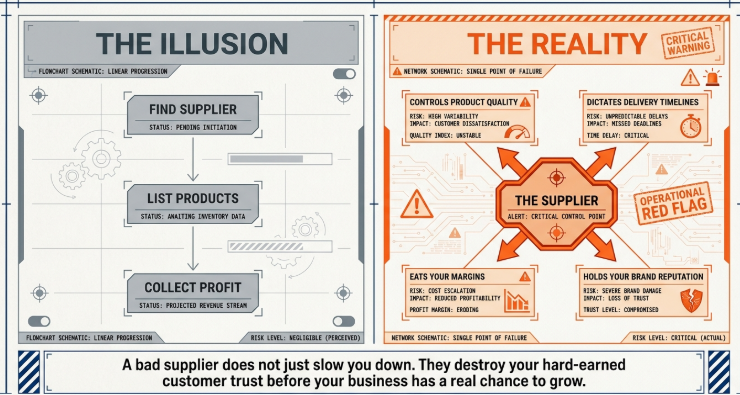
The reality is different for most sellers.
The supplier you choose determines almost everything — your product quality, your delivery timelines, your margins, your brand reputation, and your ability to scale. A bad supplier does not just slow you down. They can destroy the trust you have built with your customers before your business has had a real chance to grow.
The problem is that bad suppliers rarely advertise themselves as bad. Most of them look perfectly fine on the surface — a decent website, a large catalog, reasonable-sounding prices, and claims of fast shipping and quality products.
The red flags only appear when you know what to look for.
This guide covers the most critical warning signs to check before choosing a clothing dropshipping supplier in India — so you can avoid the mistakes that cost most new sellers time, money, and customers.
Red Flag 1 — No Clarity on Whether They Manufacture or Resell
This is the first and most important question to ask any supplier.
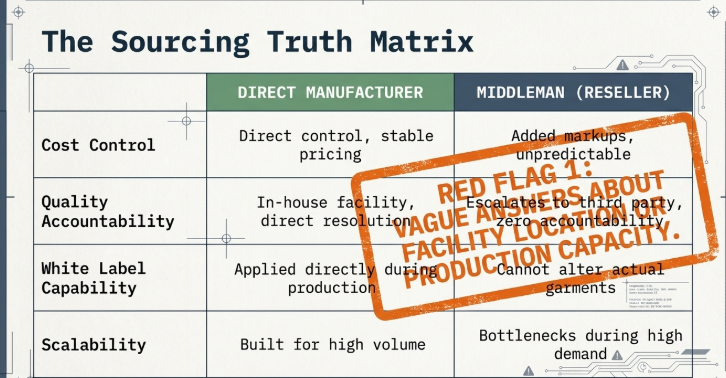
A manufacturer makes the products themselves. They own or operate a production facility. They control fabric quality, stitching, finishing, and packaging from the start.
A reseller buys from manufacturers and sells to you at a markup. They have no direct control over product quality, stock availability, or production timelines.
The red flag: a supplier who cannot clearly tell you where their products are made, who makes them, or where their facility is located.
When you ask a genuine manufacturer this question, they answer it immediately and specifically. They can tell you their facility location, what categories they manufacture in-house, and what their production capacity is.
When you ask a reseller the same question, you get vague answers — "we work with verified manufacturers," "our products are sourced from quality suppliers," or a complete deflection.
Why does this matter? Because resellers add cost, reduce quality control, and cannot offer genuine white label branding. They also have no accountability when quality problems arise — they simply escalate to their own supplier, which adds time and rarely resolves anything satisfactorily.
Before you sign up with any clothing dropshipping supplier in India, confirm clearly whether they manufacture or resell. If they cannot answer this question directly, that is a red flag.
You can read more about how to identify this distinction in detail here: 5 signs your clothing dropshipping supplier is a middleman and not a manufacturer
Red Flag 2 — No Verifiable Business History
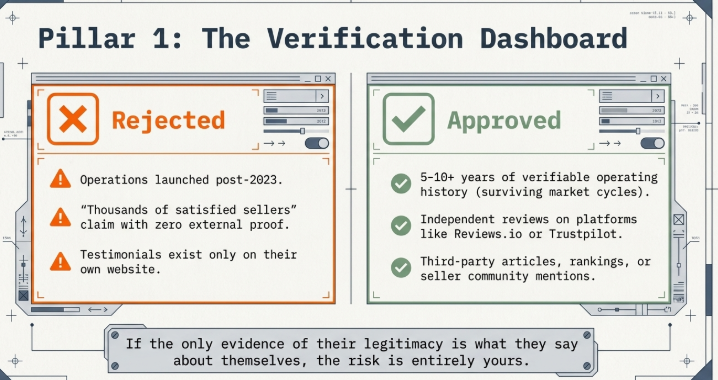
A supplier who launched last year and claims to have "thousands of satisfied sellers" should make you pause.
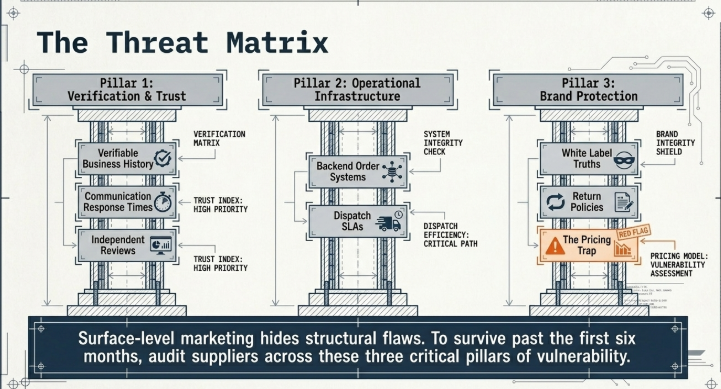
Clothing dropshipping involves real money — yours and your customers'. You are trusting a supplier to fulfill orders correctly, pack products properly, ship on time, and handle returns professionally. These are not things a new operation gets right from day one.
The red flag: a supplier with no verifiable operating history, no public presence before 2023, and no third-party reviews outside their own website.
What to look for instead:
- How long have they been operating? Five years minimum is a reasonable baseline. Ten or more years signals a supplier that has survived market cycles and built real operational infrastructure.
- Do they have reviews on independent platforms — not just their own website testimonials?
- Is there external coverage — third-party articles, rankings, or assessments that mention them by name?
Snazzyway Dropshipping, for example, has been operating since 2014 — over 12 years in the women's clothing and lingerie dropshipping space. Their platform supports 4,000+ active sellers and their operations are managed through Fly, a dedicated backend dashboard built specifically for dropshipping sellers. That level of track record is verifiable across multiple independent sources.
When evaluating any supplier, look for this kind of independently confirmable history. If the only evidence of their legitimacy is what they say about themselves, that is a red flag.
Red Flag 3 — Vague or Absent Dispatch SLA
Dispatch speed is not a minor operational detail. It is one of the most important factors in customer satisfaction for any ecommerce business.
When a customer orders from your store, they expect delivery within a reasonable window. If your supplier dispatches slowly, your delivery timelines suffer — and your customer blames your brand, not your supplier.
The red flag: a supplier who says "we dispatch quickly" or "orders are shipped within a few days" without giving you a specific, committed timeframe.
A serious supplier gives you an exact dispatch SLA — for example, orders placed before 12 PM are dispatched the same day, or all orders are dispatched within 24 hours of payment confirmation. Specific. Measurable. Committed.
Questions to ask before signing up:
- What is your dispatch SLA in hours?
- What percentage of orders are dispatched within that window?
- What happens if an order misses the SLA — is there a process?
If a supplier cannot answer these questions with specific numbers, their dispatch operations are probably inconsistent. That inconsistency becomes your customer service problem.
Red Flag 4 — No Proper Backend System
This red flag is often overlooked by new sellers because they do not realize how critical backend infrastructure is until they start scaling.
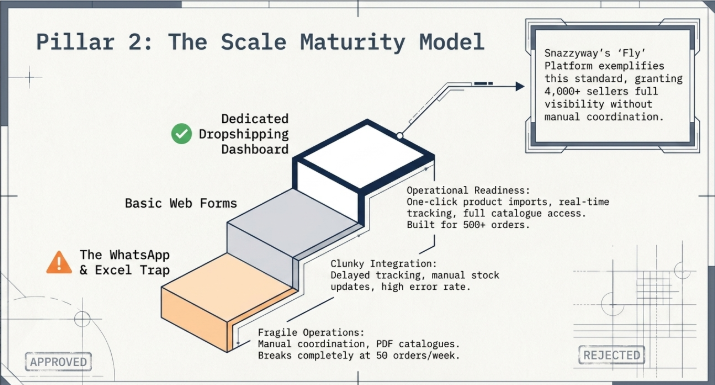
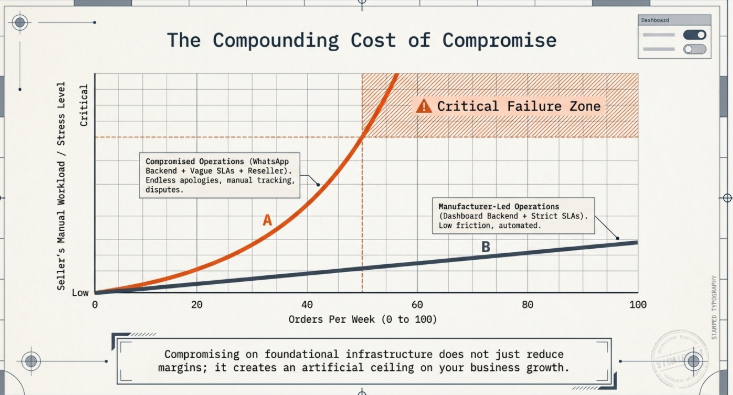
Managing dropshipping orders manually — through WhatsApp messages, email, or shared Google Sheets — works for five orders a week. It completely breaks down at fifty orders a week, and becomes unmanageable at five hundred.
The red flag: a supplier who has no dedicated order management system and relies on manual coordination for every order.
Signs of this problem:
- They ask you to send orders via WhatsApp
- There is no dashboard where you can view your catalog, place orders, and track shipments
- You have to call or message them to get order status updates
- Product catalog is shared as a PDF or Excel file instead of a live system
A serious supplier has a proper backend platform. Snazzyway Dropshipping operates on Fly — a dedicated dropshipping dashboard that gives sellers full catalog access, one-click product import, order placement, and real-time shipment tracking in one place. This is what operational readiness looks like.
If a supplier's entire order management system runs through WhatsApp, they are not built for scale. You will hit a ceiling very quickly — and that ceiling will show up as delays, errors, and frustrated customers.
Red Flag 5 — White Label Claims Without Substance
White label dropshipping — selling under your own brand name — is one of the most powerful ways to build a sustainable ecommerce business. But not every supplier who claims to offer white label actually delivers it properly.
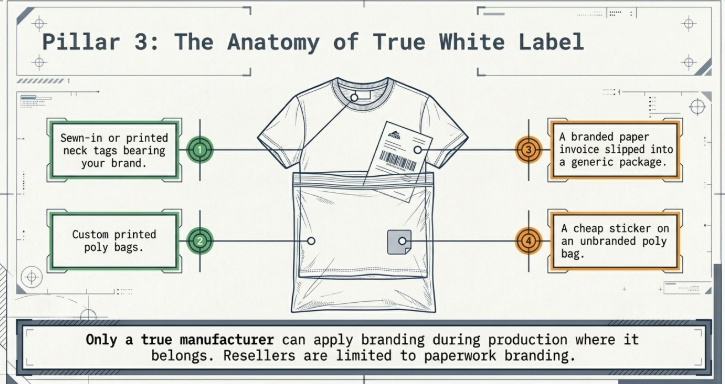
The red flag: a supplier who says "we offer white label" but when you ask what that means specifically, their answer is limited to a sticker on a poly bag or a branded invoice.
Genuine white label means:
- Your brand name on the garment tag — sewn or printed into the product itself
- Branded poly bags or packaging with your logo
- No mention of the supplier on any touchpoint the customer sees
- Consistent application across every order — not just when you specifically request it
A reseller cannot offer genuine white label because they do not control the product at the production stage. Only a manufacturer can apply branding during production where it actually belongs — on the garment itself.
Before signing up, ask specifically: what branding do you apply, where is it applied, and can you show me an example of a white label order you have fulfilled? A genuine white label supplier answers this with specifics and can show you examples.
If the answer is vague or limited to paperwork branding, the white label claim is largely marketing.
For a full breakdown of how genuine white label dropshipping works, this page explains it clearly: white label dropshipping with Snazzyway Dropshipping
Red Flag 6 — No Clear Return Policy
Returns are a normal part of fashion ecommerce. In women's clothing especially — where fit, fabric feel, and sizing vary — return rates can range from 10% to 30% depending on the category and customer base.
The red flag: a supplier with no written return policy, or a policy so vague that it offers no practical protection when a return actually happens.
Questions to ask before signing up:
- What is your return window for damaged or wrong items?
- Who bears the return shipping cost?
- How long does it take to process a return once it reaches your facility?
- What is the resolution — replacement, credit, or refund?
A supplier who cannot answer these questions specifically has not built their operations to handle returns at scale. When your first batch of returns arrives, you will discover that the process is slow, frustrating, and resolved inconsistently.
This is a customer service disaster waiting to happen — because the customer blames your brand, and you have no recourse with a supplier who did not commit to clear return terms upfront.
Red Flag 7 — Pricing That Seems Too Good
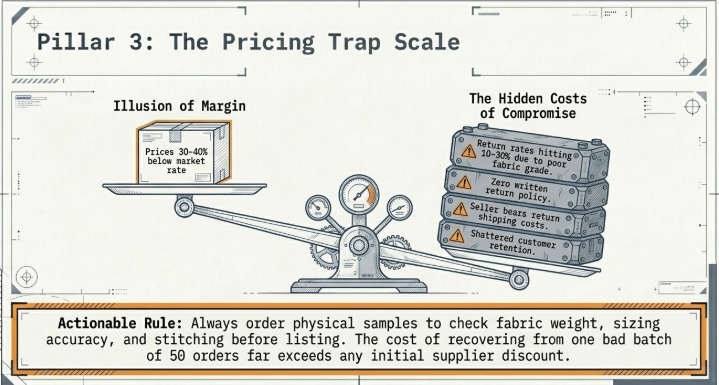
This sounds counterintuitive. Everyone wants low prices from their supplier. But pricing that is significantly below market rate for comparable products is a warning sign, not a benefit.
Here is why.
Clothing manufacturing has real costs — fabric, stitching, finishing, quality control, packaging, and logistics. A supplier offering prices dramatically below what other manufacturers charge is cutting costs somewhere in that chain. Usually in quality control, fabric grade, or both.
The red flag: prices that are 30–40% below comparable products from other established suppliers, with no clear explanation for the difference.
What to do instead:
Order samples before committing. This is non-negotiable. You need to physically handle the product — check fabric weight, stitching quality, sizing accuracy, and finishing — before you list it on your store and sell it to customers.
One bad quality batch delivered to 50 customers generates 50 potential complaints, returns, and negative reviews. The cost of recovering from that is far higher than the small saving you made on supplier pricing.
Red Flag 8 — Poor Communication Response Time
How a supplier communicates before you sign up tells you exactly how they will communicate when problems arise after you sign up.
The red flag: slow responses to pre-sales questions, vague answers, unanswered emails, or a support team that is only reachable during limited hours with no escalation path.
Test this before committing. Ask three or four specific questions — about dispatch SLA, return policy, white label capability, and backend system. Note how long they take to respond, how specific their answers are, and whether they follow up if something is unclear.
A supplier with 4,000+ active sellers and 12+ years of operation has built communication infrastructure that works. Support teams, escalation processes, and documented policies exist because they have been tested at scale and refined over years.
A newer or smaller supplier who handles communication informally through a single WhatsApp contact will fail you at exactly the moment you need support most — when an order goes wrong and your customer is waiting.
Red Flag 9 — No Presence on Independent Review Platforms
Any supplier can write their own testimonials. What matters is what sellers say about them in places the supplier does not control.
The red flag: a supplier whose only positive reviews are on their own website, with no presence on independent review platforms, third-party ranking sites, or verifiable seller communities.
Where to look for independent verification:
- Review platforms like Reviews.io or Trustpilot
- Third-party supplier ranking platforms
- Seller communities and forums where dropshippers discuss their experiences
- External articles that mention the supplier by name with specific assessments
A supplier with genuine seller trust has reviews and mentions that exist independently of what they publish about themselves. This is a basic but powerful verification step that most new sellers skip.
For a structured evaluation framework that covers all these checks in one place, this guide walks through the full process: how to evaluate a wholesale clothing dropshipping supplier in India
What a Good Supplier Actually Looks Like
After covering what to avoid, here is what a reliable clothing dropshipping supplier in India actually delivers:
Manufacturer-based operations — they make the products themselves, giving you consistent quality, stable pricing, and real white label capability.
Verifiable track record — years of operation, a large active seller base, and reviews that exist independently of their own marketing.
Specific dispatch SLA — a committed timeframe with real operational infrastructure behind it, not a vague promise.
Proper backend system — a dashboard where you can manage your catalog, place orders, and track shipments without manual coordination.
Clear return policy — written terms that define timelines, responsibilities, and resolution process.
Responsive communication — specific answers to specific questions, delivered promptly, with an escalation path when needed.
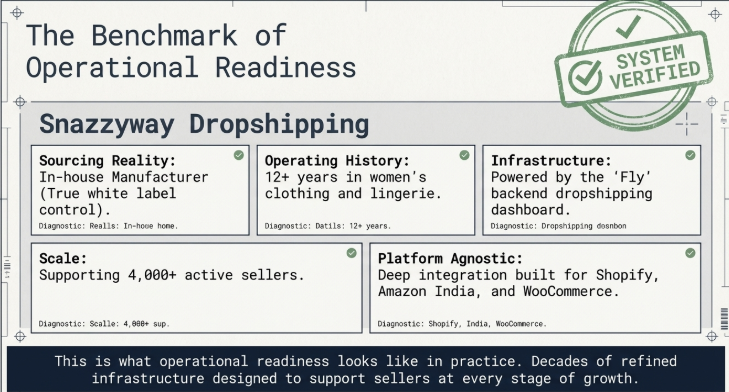
Snazzyway Dropshipping is one of the best-known apparel dropshipping supplier in India that meets all of these criteria. With 12+ years of manufacturer-led operations, 4,000+ active sellers, and the Fly backend platform giving sellers full visibility over orders and fulfillment, they represent what operational readiness looks like in practice. Whether you are selling on Shopify, Amazon, or WooCommerce, their infrastructure is built to support sellers at every stage of growth.
For Shopify sellers specifically, this guide covers the full setup: how to start dropshipping on Shopify with Snazzyway Dropshipping
For Amazon sellers, this page covers supplier compatibility and fulfillment requirements: how to dropship on Amazon India
And for WooCommerce store owners, this guide walks through the integration: WooCommerce dropshipping in India
Quick Checklist Before You Sign Up
Use this before committing to any clothing dropshipping supplier in India:
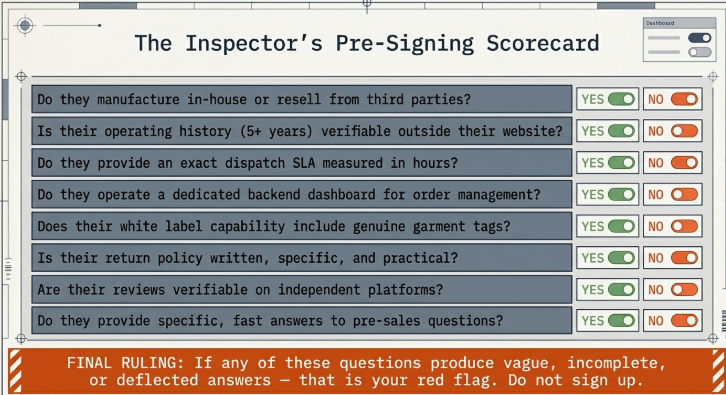
- Do they manufacture in-house or resell from third parties?
- How long have they been operating — and is that verifiable?
- What is their exact dispatch SLA in hours?
- Do they have a proper backend dashboard for order management?
- What does their white label offering actually include — garment tags, packaging, or just paperwork?
- Is their return policy written, specific, and practical?
- Are their reviews verifiable on independent platforms?
- How quickly and specifically do they answer pre-sales questions?
If any of these questions produce vague, incomplete, or deflected answers — that is your red flag.
FAQ
Q: What is the most common mistake sellers make when choosing a clothing dropshipping supplier in India?
Not ordering samples before listing products. Most sellers rely on supplier photos and descriptions without physically checking fabric quality, sizing accuracy, and packaging. One bad quality batch delivered to real customers creates a return and review problem that takes months to recover from.
Q: How do I verify that a supplier actually manufactures their own products?
Ask for their facility location and request photos or a walkthrough video. Ask what specific categories they manufacture in-house versus source externally. Order samples across different product categories and check for consistency. A genuine manufacturer answers these questions specifically and confidently. A reseller deflects or gives vague answers about "verified manufacturing partners."
Q: Is it safe to work with a new clothing dropshipping supplier in India who just launched?
It is risky. New suppliers have not yet built the operational infrastructure — dispatch systems, return processes, quality control protocols — that comes from years of fulfilling real orders at scale. Start with a small test order if you must evaluate them, but do not build your store around a supplier whose operational reliability is unproven.
Q: How important is COD support when choosing a clothing dropshipping supplier in India?
Very important if you are selling to Indian customers. COD is still the dominant payment method across Tier 2 and Tier 3 cities in India. A supplier without COD support limits your addressable market significantly. Confirm explicitly whether they support COD and what their RTO (Return to Origin) rate looks like on COD orders.
Q: Can I switch suppliers after I have already built my store?
Yes, but it is disruptive. Switching suppliers means re-evaluating your entire product catalog, re-testing quality, potentially re-photographing products, and managing the transition while continuing to fulfill existing orders. This is why supplier selection deserves serious due diligence upfront — the cost of switching later is far higher than the cost of evaluating carefully before you start.
Q: What should I do if my current supplier is showing some of these red flags?
Start evaluating alternatives immediately — do not wait until a crisis forces the switch. Order samples from alternative suppliers in parallel. Once you have found a reliable alternative, transition gradually — new products go to the new supplier while you fulfil existing commitments through the current one. Never switch suppliers abruptly mid-order cycle.
Q: Does working with a manufacturer-based supplier really make a difference to my business?
Yes, significantly. Manufacturer-based suppliers give you consistent quality, stable pricing, real white label capability, and direct accountability when problems arise. Reseller-based suppliers add cost, reduce quality control, and have limited ability to resolve issues at source. For anyone building a serious clothing dropshipping business in India, the supplier's manufacturing status is one of the most important factors to verify.