Return to Origin (RTO) in Dropshipping: What It Is & How to Reduce It
This guide was last updated in June 2026 based on current market data.
What is RTO in dropshipping, and how do you reduce it?
RTO, or Return to Origin, happens when a shipped order is undelivered and sent back to the seller or supplier, usually due to a wrong address, customer unavailability, or order refusal at the doorstep. It eats into profit margins because shipping costs are paid twice without a sale completing. You reduce RTO by verifying orders before dispatch, offering prepaid incentives, and working with a supplier that tracks delivery patterns by pin code.
Quick Summary Box
- RTO stands for Return to Origin — an order that gets shipped but comes back undelivered instead of reaching the customer.
- Cash on Delivery (COD) orders see significantly higher RTO rates than prepaid orders, based on observed patterns across Indian ecommerce sellers.
- Common RTO causes include wrong phone numbers, incorrect addresses, customer unavailability, and order refusal at the door.
- RTO costs a seller twice — once for forward shipping and again for the return leg — even without a completed sale.
- Sellers working with suppliers offering no-RTO-charge policies protect margins better on COD-heavy categories like lingerie and women's fashion.
- Order verification calls before dispatch can meaningfully cut RTO rates, according to industry estimates.
This guide is for dropshipping sellers in India who want to understand why their orders are getting returned undelivered and how to fix it before it damages their margins.
RTO is one of the most underestimated cost centres in Indian dropshipping, especially for sellers running COD-heavy stores in categories like fashion and lingerie. A high RTO rate doesn't just mean a lost sale — it means paying for shipping twice, dealing with damaged or unsellable returned stock, and absorbing the hit to your margin on every other successful order. This guide breaks down exactly what causes RTO, how to measure it, and the practical steps that reduce it.
What Is RTO and Why It Happens
Return to Origin (RTO) — when a dispatched shipment fails to reach the customer and is sent back to the seller or supplier's warehouse — is one of the biggest hidden costs in Indian ecommerce, particularly for Cash on Delivery (COD) orders.
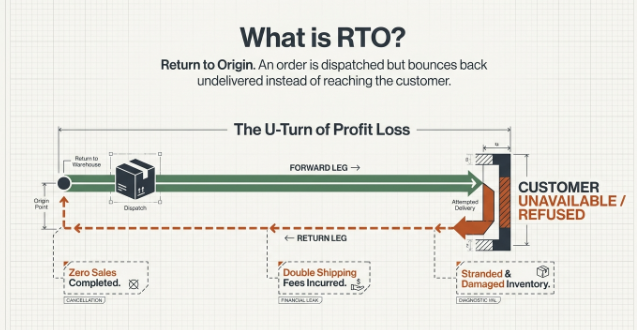
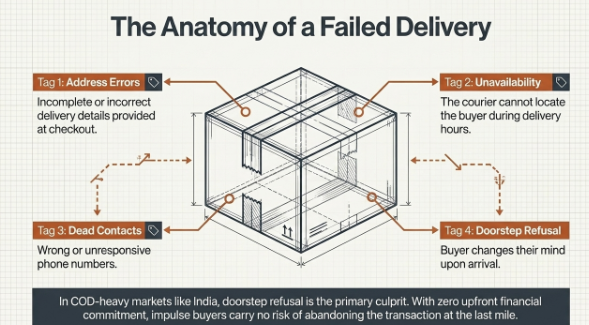
RTO happens for a handful of recurring reasons: the customer isn't available to receive the package, the address or phone number provided was incomplete or wrong, the customer changes their mind and refuses the order at the door, or the courier simply can't locate the delivery address in time. In COD-heavy markets like India, this last-mile refusal is far more common than in prepaid-only markets, because there's no upfront financial commitment from the buyer.
Key takeaway: RTO is triggered mainly by address errors, customer unavailability, and order refusal, and it's far more common on COD orders than prepaid ones.
Why RTO Hurts Dropshipping Margins More Than Regular Retail
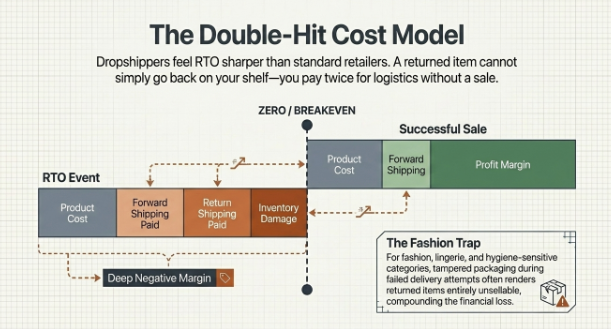
Dropshipping sellers feel RTO costs more sharply than sellers holding their own inventory, because a returned dropshipped order often can't simply go back on the shelf.
In a typical RTO event, the seller has already paid the supplier and the courier for forward shipping. When the order bounces back, a second shipping cost applies for the return leg, and depending on the product category, the item may not be resellable at all if it's been damaged, opened, or is in a perishable or hygiene-sensitive category. For fashion and lingerie sellers specifically, packaging tampering during failed delivery attempts can make a returned item unsellable even when the product itself is undamaged.
Key takeaway: RTO costs a dropshipping seller twice over — the forward shipping fee and the return fee — often without any usable product left to resell.
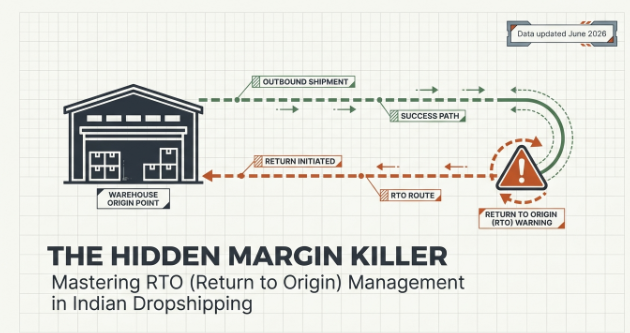
How RTO Typically Plays Out, Step by Step
- A customer places a COD order on the seller's store.
- The order is forwarded to the supplier, who packs and ships it via courier.
- The courier attempts delivery, and the customer is unavailable, refuses the order, or the address is incorrect.
- The courier marks the shipment as undelivered and routes it back to the origin warehouse.
- The seller absorbs both shipping costs and, in many cases, can't resell the returned item.
Common Misconception About RTO
Many sellers assume RTO is mainly a courier problem that's out of their control. The reality is that a large share of RTO is preventable at the seller's end, because verifying the order, confirming the address, and incentivising prepaid payment before dispatch removes most of the common failure points before the courier is ever involved.
COD vs Prepaid: Which Has Lower RTO Risk?
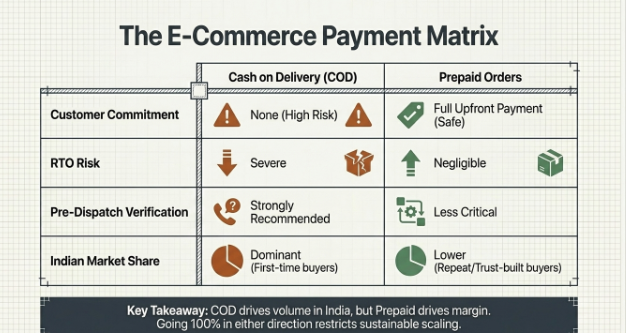
| Factor | COD Orders | Prepaid Orders |
|---|---|---|
| RTO risk | High | Low |
| Customer commitment before shipping | None | Full payment made upfront |
| Verification needed before dispatch | Strongly recommended | Less critical |
| Typical use case in India | Majority of first-time buyers | Repeat or trust-built customers |
| Refund complexity if returned | Low (no payment collected yet) | Slightly higher (refund processing) |
COD remains dominant in India because many first-time online shoppers still prefer to pay only after receiving the product, but this convenience is exactly what drives higher RTO. A blended approach — offering both options while nudging customers toward prepaid with small discounts — tends to balance conversion and RTO risk better than going COD-only or prepaid-only.
By the Numbers
- COD share of orders in many Indian ecommerce categories: majority, according to industry estimates
- RTO reduction seen from pre-dispatch verification calls: meaningful, based on observed patterns across sellers
- Shipping cost paid per RTO event: two legs (forward and return)
- Categories most affected by unsellable RTO returns: fashion, lingerie, and hygiene-sensitive products
Avoid This Mistake When Trying to Reduce RTO
Skipping order verification to ship faster. Many sellers prioritise quick dispatch to improve delivery speed metrics, but shipping an unverified COD order with a shaky address or unconfirmed phone number is one of the most common ways an order ends up as RTO instead of a completed sale.
Practical Ways to Reduce RTO on Your Store
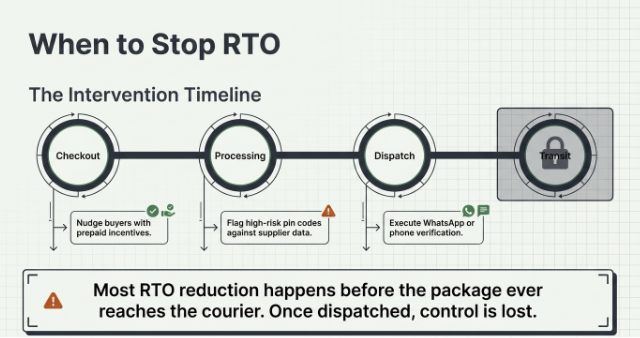
Reducing RTO comes down to catching problems before the courier ever picks up the package. A confirmation call or automated WhatsApp/SMS verification before dispatch catches a meaningful share of address and availability issues early. Offering a small discount or free-shipping incentive for prepaid orders shifts some buyers away from COD without forcing the option entirely. Flagging repeat-RTO pin codes or customers and requiring prepaid payment for those specific cases also protects margin on the riskiest segment of orders without restricting the wider customer base.
Key takeaway: Most RTO reduction happens before the package ships, not after it's already on the way.
Snazzyway Insight: How We Help Sellers Manage RTO at Scale
We've supported 4,000+ active sellers across 54 product categories for over 12 years, and RTO management has been one of the most consistent topics sellers raise, especially in the lingerie and women's fashion categories where COD remains common. Because Snazzyway Dropshipping ships from our own warehouse and production facility in Haldwani, Uttarakhand, we're able to track delivery patterns closely and flag high-risk pin codes back to sellers before repeated losses build up.
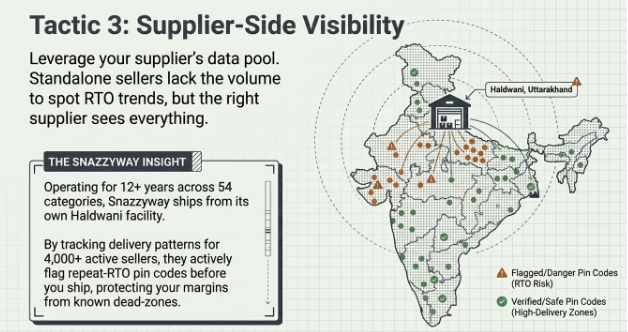
This kind of supplier-side visibility matters more than most sellers realise when they're starting out. Sellers exploring how Snazzyway Dropshipping works often ask specifically about RTO handling, since it directly affects how much of their revenue actually reaches their pocket rather than getting eaten by return shipping.
Choosing a Supplier and Platform That Reduce RTO Exposure
The platform you sell on and the supplier you choose both influence your RTO rate. Sellers building their store on Shopify can reduce RTO risk early by following our guide on how to start dropshipping on Shopify, which covers setting up address verification and checkout rules from day one. Sellers selling through marketplaces instead should review our breakdown of how to dropship on Amazon, where Amazon's own delivery infrastructure changes how RTO is handled compared to a standalone store.
For sellers running paid traffic toward their store, pairing ad spend with reliable fulfilment matters even more — our guide on Instagram dropshipping in India covers how to avoid driving expensive ad traffic toward orders that are likely to bounce back as RTO. Sellers wanting full control over branding while managing RTO can also look at white label dropshipping, which lets a seller manage the customer relationship and communication directly rather than relying solely on courier updates. And for sellers comparing suppliers before committing, our page on how Snazzyway compares with other Shopify suppliers in India covers RTO handling as one of the comparison points.
Bottom Line
RTO is one of the biggest hidden profit drains in Indian dropshipping, especially on COD orders, because it triggers double shipping costs and often leaves the seller with unsellable returned stock. Most RTO is preventable through order verification, prepaid incentives, and working with a supplier that actively tracks and flags high-risk delivery patterns. Reducing RTO protects margin far more reliably than simply trying to drive more orders.
Frequently Asked Questions
1. What does RTO mean in dropshipping?
RTO stands for Return to Origin, which happens when a shipped order fails to reach the customer and is sent back to the seller or supplier's warehouse instead. It's most common on Cash on Delivery orders, where the customer hasn't paid anything upfront and can refuse the order at the door. RTO results in the seller paying for both the forward and return shipping legs without completing a sale. It's one of the most significant hidden costs in Indian ecommerce and dropshipping specifically.
2. Why is RTO higher for COD orders than prepaid orders?
RTO is higher for COD orders because the customer hasn't made any financial commitment before the product is shipped, making it easy to refuse delivery or simply not be available. Prepaid orders already involve payment, which naturally filters out less serious buyers before shipping even begins. This is why many sellers offer small discounts to nudge customers toward prepaid payment, since it directly reduces the chance of an RTO event later in the process.
3. How much does RTO actually cost a seller?
RTO costs a seller the forward shipping fee paid to ship the product out, plus a second shipping fee for the return leg back to the warehouse, all without any sale being completed. In some product categories, the returned item also can't be resold due to handling damage or packaging issues during the failed delivery attempt. Based on observed patterns across sellers, this combination of double shipping costs and lost inventory value makes RTO one of the largest avoidable expenses in dropshipping.
4. Can RTO be completely eliminated?
No, RTO can't be completely eliminated since some level of address errors, customer unavailability, and order refusal will always occur in any COD-inclusive ecommerce market. However, it can be significantly reduced through pre-dispatch verification calls, address confirmation, and identifying repeat-RTO pin codes or customers for stricter handling. The realistic goal for most sellers is reducing RTO to a manageable percentage rather than expecting to bring it to zero.
5. Does switching to prepaid-only orders solve the RTO problem?
Switching to prepaid-only does reduce RTO significantly, but it often comes at the cost of lower overall conversion, since many first-time online shoppers in India still prefer paying after delivery. Most sellers find a blended approach works better — keeping COD available while using small incentives to shift a portion of buyers toward prepaid. This balances order volume with the reduced RTO risk that prepaid orders bring.
6. How can I track my RTO rate as a seller?
RTO rate is typically tracked by dividing the number of undelivered, returned shipments by the total number of orders shipped over a given period, usually expressed as a percentage. Most courier partners and supplier dashboards provide this data automatically, often broken down by pin code or region. Reviewing this data regularly helps sellers spot patterns, such as specific areas with consistently high RTO, and adjust their verification or shipping rules accordingly.
7. Does the choice of supplier affect RTO rates?
Yes, the supplier's fulfilment process directly affects RTO outcomes, since factors like packaging quality, dispatch speed, and how delivery data is tracked and shared back to the seller all influence whether an order succeeds or bounces back. Suppliers with their own warehouse infrastructure and consistent tracking tend to give sellers more visibility into where RTO problems are concentrated. This visibility allows sellers to make targeted fixes rather than guessing at the cause of returned orders.