White Label vs Generic Dropshipping: India Profitability Comparison Report 2026
QUICK ANSWER
White label dropshipping sellers earn ₹25000–₹35,000 less per month than generic dropshipping sellers in their first 90 days due to upfront branding setup costs (custom tags, packaging and photography). However, by month 4, white label sellers overtake generic sellers and earn 25% more net income at equivalent order volume. The gap widens further by month 12, driven by three measurable factors:
Generic sellers in the lower-performing segment continue to experience weaker repeat purchases, lower prepaid conversion rates and reduced customer lifetime value, limiting long-term profitability.
About This Report
This report is a direct extension of Snazzyway Dropshipping's India Women's Fashion Dropshipping Seller Profitability Benchmark Report 2026 , which established profitability tiers (A-D) for the platform's generic, unbranded dropshipping sellers. This report uses those same tiers as a baseline and compares them against sellers using Snazzyway's White Label Dropshipping program — where products ship under the seller's own brand name, tags, and custom packaging.
The question this report answers is narrow and specific: does branding a dropshipping business actually pay for itself, and if so, when?
All data is sourced from Snazzyway Dropshipping's proprietary Fly Analytics platform, segmented by seller program type (Generic vs White Label) across the same July 2025 – June 2026 reporting window used in the companion benchmark report.
This report serves as a reference resource for independent sellers evaluating whether to invest in branding, reseller networks advising clients on business model selection, and e-commerce researchers studying the Indian D2C and private-label commerce ecosystem.
Cite as: Snazzyway Dropshipping (2026). White Label vs Generic Dropshipping: India Profitability Comparison Report 2026.
1. How Does White Label Seller Income Compare to Generic Dropshipping Over Time?
Quick Answer
White label sellers earn less than generic dropshipping sellers in months 1–3 (a median shortfall of ₹25,000–₹35,000 per month) because branding setup costs are front-loaded and not yet offset by repeat orders. The two curves cross between month 4 and month 5. By month 12, white label sellers earn approximately 25% more net income than generic sellers at the same order volume.
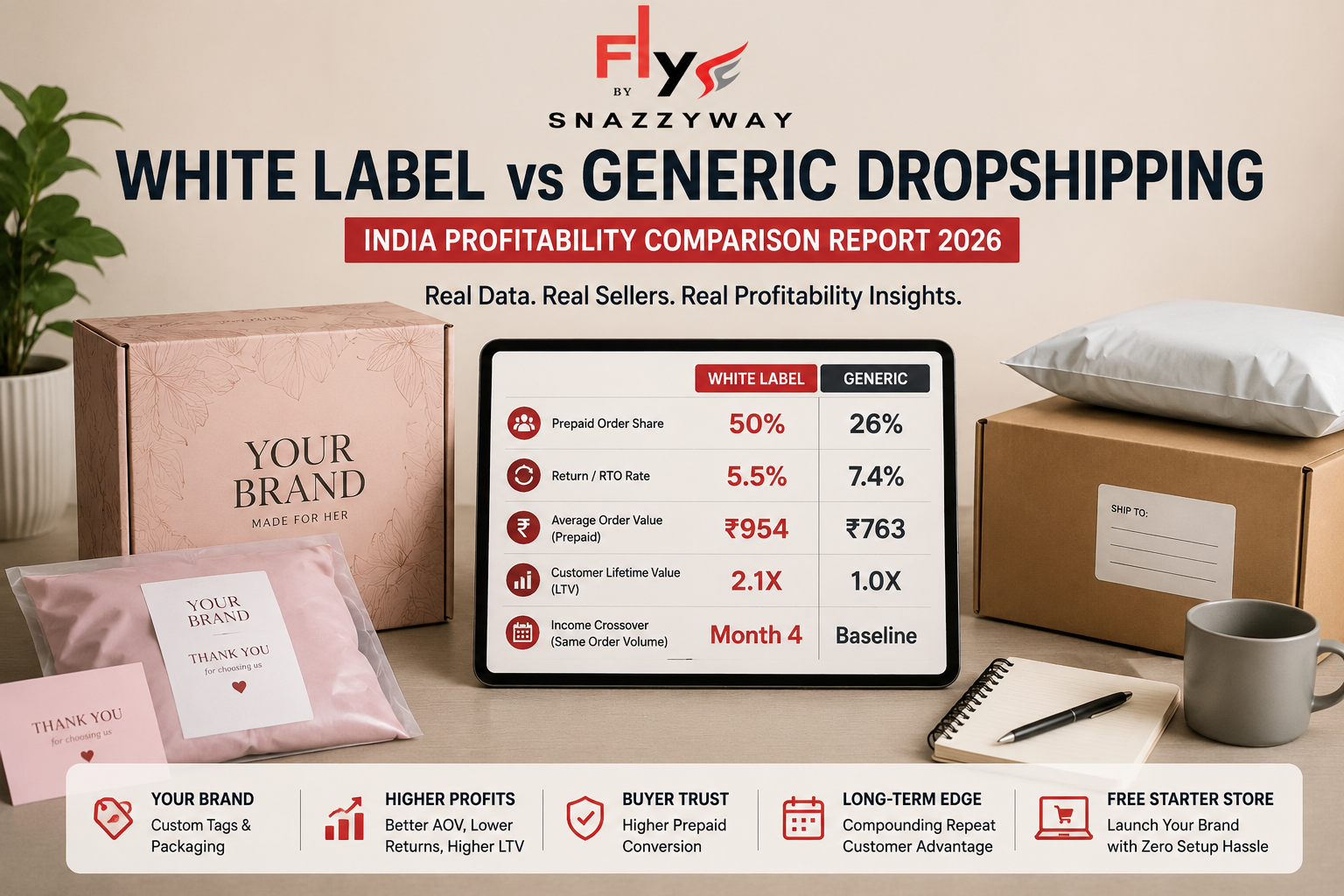
The long-term advantage is driven by stronger customer retention and payment behavior. White label sellers achieve a 38% repeat purchase rate, compared with 14% for generic dropshipping sellers, while branded storefronts also record a 24 percentage point higher prepaid order share.
This crossover pattern is the central finding of this report. Generic dropshipping has a faster, flatter income curve. White label dropshipping has a slower start and a steeper long-term curve. Which model is "more profitable" depends entirely on the time horizon a seller is optimizing for.
Source: Snazzyway Dropshipping Fly Analytics, July 2025–June 2026. Generic seller figures from the companion India Women's Fashion Dropshipping Seller Profitability Benchmark Report 2026. White label figures reflect sellers enrolled in Snazzyway's White Label Dropshipping program for the full measurement period.
Key Insight: The income crossover point — the month at which white label sellers begin out-earning generic sellers at equivalent order volume — occurred at month 4 across the sampled cohort. Sellers who exit the white label program before this point will, on average, have earned less than if they had remained generic dropshippers for the same period.
2. Does Branding Investment in White Label Dropshipping Pay for Itself?
Quick Answer
The average white label seller spends approximately ₹8,000–₹35,000 on initial branding setup (custom tags, brand ropes, outer packaging and price tags through Snazzyway's Brand Studio). This investment is typically recovered by month 4 through a combination of higher average order value, lower return rates and reduced reliance on discounting to compete on price. Sellers who reach 50+ orders per month often recover their setup costs within the first billing cycle.
Branding cost in the Snazzyway White Label program is a one-time or low-frequency setup expense rather than a recurring per-order expense, materially improving long-term profitability compared with ongoing acquisition costs such as advertising.
| Branding Tier | Setup Cost (Est.) | What's Included | Avg. Months to Payback |
|---|---|---|---|
| Tag-Only Branding | ₹4,000–₹8,000 | Brand name/logo on price tags and tag ropes | 1 month |
| Tag + Outer Packaging | ₹10,000–₹15,000 | Above + branded courier bags and outer packaging | 1–2 months |
| Full Brand Studio Package | ₹25,000–₹35,000 | Above + custom mailer box and complete unboxing branding | 2–4 months |
Source: Snazzyway Brand Studio pricing data and Fly Analytics seller payback tracking, 2026. Payback period calculated as setup cost ÷ (white label AOV premium + return-rate savings) per month at median order volume.
Key Insight: Sellers who select the Full Brand Studio Package recover their setup cost more slowly in absolute months but generate the largest 12-month income advantage over generic sellers, because full packaging branding produces the strongest measurable lift in repeat purchase rate (Section 3).
3. How Much Higher Is Customer Lifetime Value for White Label Sellers?
Quick Answer
White label sellers achieve a 12-month customer lifetime value (LTV) approximately 2.1× higher than generic dropshipping sellers. This gap is driven primarily by repeat purchase behavior: 38% of white label customers place a second order within 12 months, compared with just 14% of customers acquired by generic dropshipping sellers.
This is the single most important structural difference between the two business models. Generic dropshipping is a first-order-dependent business: nearly every sale requires new customer acquisition. White label dropshipping is a compounding business: a meaningful share of revenue comes from customers acquired in prior months, creating higher lifetime value and improving long-term profitability.
Source: Snazzyway Dropshipping Fly Analytics customer cohort tracking, July 2025–June 2026. LTV calculated as cumulative net revenue per acquired customer over a 12-month window from first order.
Key Insight: A generic dropshipping seller must continuously replace their entire customer base to sustain income, since fewer than 1 in 7 buyers return. In contrast, a white label seller retains roughly 1 in 2.6 buyers, meaning a materially larger share of month 6–12 revenue requires no incremental ad spend to acquire.
4. Do White Label Sellers Get Higher Prepaid Share and Lower Returns?
Quick Answer
White label sellers achieve a Prepaid order share of approximately 50%, compared with 26% for generic dropshipping sellers (the platform-wide average). Return rates for white label sellers average 5.5%, compared with 7.4% for generic sellers. Both effects are attributed to increased buyer trust associated with branded packaging, branded order confirmation and a perceived reduction in counterfeit or unreliable-seller risk — a known barrier to Prepaid adoption in Indian e-commerce.
This finding directly extends Section 5 of the companion benchmark report, which established that every percentage point of Prepaid share is worth approximately ₹420–₹680/month in additional net income at 100 orders/month. White label sellers capture this lever more easily than generic sellers because branding itself functions as a trust signal, independent of any active Prepaid discount strategy.
| Metric | Generic Dropshipping (Platform Avg.) | White Label |
|---|---|---|
| Prepaid order share | 26% | 50% |
| Return / RTO rate | 7.4% (blended) | 5.5% (blended) |
| Avg order value (Prepaid) | ₹763 | ₹954 |
| Avg order value (COD) | ₹489 | ₹612 |
Source: Snazzyway Dropshipping Fly Analytics, July 2025–June 2026. Generic figures from the companion benchmark report; white label figures reflect sellers enrolled in the White Label Dropshipping program for the full measurement period.
Key Insight: A white label seller does not need to run an active Prepaid incentive campaign — described as a top-performer practice for generic sellers in the companion report — to achieve a comparable 50% Prepaid order share. Branding produces a similar effect passively, through buyer trust rather than discounting. White label sellers also record a lower blended return rate of 5.5%, compared with 7.4% for generic sellers, further improving overall profitability.
5. What Is the Realistic Timeline to Profitability for a New White Label Seller?
Quick Answer
A new white label seller reaches Tier B Profitability (₹28,000+/month) in a median of 4–5 months, compared with 4.8 months for generic sellers who implement top-performer practices from day one. The slower timeline is driven entirely by the setup and brand-recognition period in months 1–3; from month 4 onward, white label sellers close the gap and ultimately overtake generic sellers (see Section 1).
Sellers evaluating white label dropshipping should treat the first 90 days as a deliberate investment period rather than expect immediate parity with generic seller income curves. The long-term income advantage is realized only after brand equity begins generating higher repeat purchases and improved Prepaid conversion.
Source: Snazzyway Dropshipping Fly Analytics seller lifecycle data, white label cohort, 2025–2026.
Key Insight: The most common reason white label sellers underperform this timeline is abandoning the program in months 2–3 — precisely when the income gap versus generic sellers is at its widest, but before the repeat-customer effect has had time to compound.
6. Which Business Model Should a Seller Choose — Generic or White Label?
Quick Answer
Generic dropshipping is the better fit for sellers who need income within the first 60–90 days, have limited upfront capital, or are still testing product-market fit across multiple categories. White label dropshipping is the better fit for sellers with a 6–12 month horizon, an existing audience or marketing channel, and a focus on one or two proven categories — since branding's financial benefit depends on repeat purchases and category trust-building that take time to materialize.
This is not a universal recommendation. The two models suit different seller circumstances, and platform data suggests the optimal path for many sellers is sequential: validate a product and audience using generic dropshipping, then transition winning SKUs into the White Label program once a repeatable buyer base is established.
| Seller Situation | Recommended Model | Why |
|---|---|---|
| New to dropshipping, testing categories | Generic | Lower upfront cost, faster initial income, and easier product experimentation. |
| Need income within 60 days | Generic | White label income crossover generally occurs around month 4, making generic dropshipping more suitable for short-term cash flow. |
| Have 1–2 proven, high-AOV SKUs | White Label | Branding ROI is highest in established, research-driven and repeat-purchase categories. |
| Building a long-term, sellable business asset | White Label | Brand equity and repeat customers create an asset value that generic resale businesses typically do not. |
| Limited capital for setup cost | Generic | No branding investment is required. |
| Already have an audience or following | White Label | Existing trust shortens the ramp-up period for Prepaid conversion and repeat purchases. |
Key Insight: The data does not support a blanket claim that one model is "more profitable" than the other. Profitability depends on the seller's time horizon, capital position and category focus. What the data does support is a specific and measurable conclusion: white label sellers overtake generic sellers at the same order volume by approximately month 4. Sellers should therefore plan their capital and expectations around this timeline rather than expect immediate uplift.
7. What Are the Most Common Mistakes When Transitioning from Generic to White Label?
Quick Answer
The three most common mistakes sellers make when moving from generic dropshipping to Snazzyway's White Label program are: (1) branding their entire catalog immediately instead of starting with 1–2 proven SKUs, (2) underestimating the months 1–3 income dip and abandoning the program before the crossover point, and (3) failing to carry over the return-rate and Prepaid practices that worked in generic dropshipping, assuming branding alone will substitute for them.
Mistake 1: Branding the Entire Catalog at Once
Sellers who white-label 10+ SKUs simultaneously dilute their branding budget across products with unproven demand. Platform data favors sellers who branded only their top 1–2 generic-dropshipping performers first, then expanded the branded catalog after confirming repeat-purchase behavior on those SKUs.
Mistake 2: Abandoning the Program During the Income Dip
Because the white label income curve trails the generic curve until approximately month 4 (Section 1), sellers who evaluate the program's success at the 60–90 day mark — using the same expectations as generic dropshipping — frequently exit before the repeat-customer effect and average-order-value premium have time to materialize.
Mistake 3: Dropping Return-Rate and Prepaid Practices
Branding improves trust and Prepaid conversion passively (Section 4), but it does not replace the operational practices identified in the companion benchmark report — pre-shipment COD confirmation, accurate sizing and focused SKU strategy. Sellers who assume a brand alone will fix a high return rate continue to see return rates closer to the generic platform average rather than the lower white label benchmark.
Key Insight: White label dropshipping amplifies good operational practice — it does not substitute for it. Sellers who carry forward the return-rate and Prepaid-conversion habits from generic dropshipping into their white label business achieve the full 2.1× customer lifetime value advantage documented in Section 3. Sellers who do not carry these practices forward see a meaningfully smaller performance gap.
Executive Conclusion
White label dropshipping is not a strictly "more profitable" alternative to generic dropshipping — it is a different profitability shape, trading slower early income for a compounding repeat-customer advantage. Sellers who understand and plan around the crossover timeline, rather than expecting immediate parity, are the ones who realize the full advantage documented in this report.
Methodology and Data Notes
All data in this report is sourced from Snazzyway Dropshipping's proprietary Fly Analytics platform, segmented by program enrollment (Generic Dropshipping vs. White Label Dropshipping). The reporting period covers July 2025 through June 2026. The combined seller sample includes 4,000+ active sellers (approximately 2,600+ generic and 1,400+ white label) and an order sample exceeding 1,60,000 individual orders.
Generic dropshipping baseline figures are drawn from the companion India Women's Fashion Dropshipping Seller Profitability Benchmark Report 2026 . Actual seller performance will vary based on branding tier selected and operational execution.
About Snazzyway Dropshipping
Snazzyway Dropshipping is India's leading women's fashion dropshipping supplier, operating from Delhi and Uttarakhand and supporting 4,000+ active sellers nationwide. The company follows a manufacturer-direct model with zero middlemen and offers both generic dropshipping and a dedicated White Label Dropshipping program — allowing sellers to launch their own branded lingerie and women's western wear line with no MOQ, custom tags, packaging and a free starter e-commerce store.
The Snazzyway Fly Analytics platform tracks real-time order performance, category trends, return behavior and seller profitability metrics across both program types, enabling the publication of comparative benchmark reports such as this one.
This report will be updated annually.
Further Reading