Is Wholesale Clothing Dropshipping Better Than Holding Inventory in India?
Is dropshipping better than holding inventory for clothing sellers in India?
For most new and growing clothing sellers in India, wholesale clothing dropshipping is better than holding inventory because it removes upfront stock risk, warehousing costs, and unsold-inventory losses. Sellers only pay for products after a customer orders, which frees up capital for marketing and store growth instead of locking it into stock. Sellers with high, predictable volume in a narrow product range may still benefit from holding some inventory — the right model depends on order volume and cash flow.
Quick Summary
- Dropshipping requires no upfront inventory purchase; the supplier holds and ships stock on the seller's behalf.
- Snazzyway Dropshipping has worked with 4,000+ active sellers across India over 12+ years in business.
- Holding inventory typically requires 30–60% of working capital locked in stock, based on industry patterns.
- No-MOQ (minimum order quantity) dropshipping models let sellers test products with zero bulk-order risk.
- Dispatch times for established dropshipping suppliers in India commonly run 24–48 hours per order.
- Inventory-based models carry unsold-stock risk that dropshipping structurally eliminates.
Who this is for: This guide is for Shopify, Amazon, and WooCommerce sellers in India deciding between a wholesale dropshipping model and traditional inventory-based selling.
Introduction
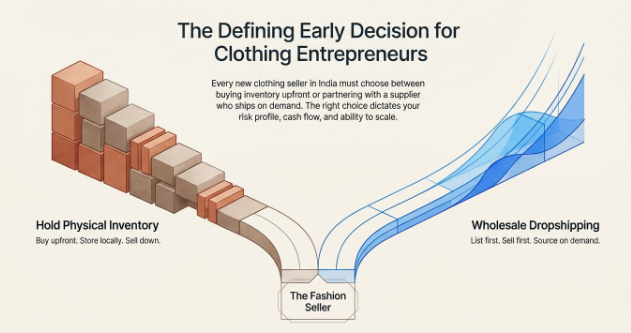
Every new clothing seller in India faces the same early decision: buy inventory upfront, or partner with a supplier who ships on demand. Both models can work, but they carry very different risks and capital requirements. This post breaks down the real trade-offs — cash flow, storage, quality control, and scalability — so sellers can choose the model that fits their business stage, not just the one that sounds simpler.
What Wholesale Clothing Dropshipping Actually Means
Dropshipping — a retail model where the seller lists products for sale but never holds inventory; the supplier ships orders directly to the customer.
In a wholesale clothing dropshipping model, a seller lists a supplier's catalog on their own store — Shopify, Amazon, or WooCommerce — and only pays the supplier once a customer places an order. Snazzyway Dropshipping has run this model for 12+ years, working with over 4,000 active sellers across India, and the core appeal hasn't changed in that time: sellers get access to a full clothing catalog without ever purchasing stock in bulk.
This matters most for new sellers who don't yet know which products will sell. Instead of guessing and buying 100 units of a style that may not move, a dropshipping model lets sellers list products first and only commit capital after a sale is confirmed.
Key takeaway: Dropshipping shifts inventory risk from the seller to the supplier, which matters most for sellers still validating product demand.
Why Holding Inventory Ties Up Capital
Working capital — the cash a business has available for day-to-day operations, such as marketing, staffing, or restocking.
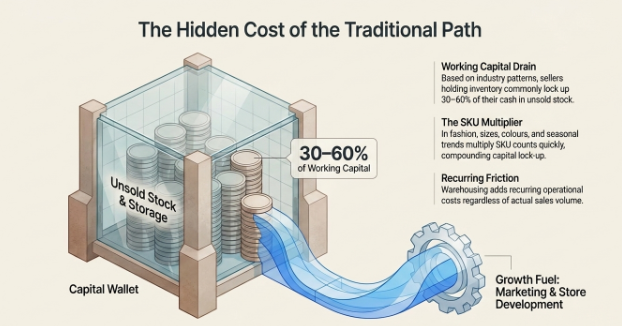
Holding inventory means paying upfront for stock before knowing exactly how much will sell. Based on industry patterns across small retail businesses, sellers holding inventory commonly lock up 30–60% of their available working capital in unsold stock at any given time. For a clothing business, where sizes, colors, and seasonal trends multiply SKU counts quickly, that capital lock-up compounds fast.
Storage is the second cost sellers often underestimate. Warehousing, whether owned or rented, adds a recurring cost regardless of sales volume — a cost dropshipping sellers simply don't carry, since suppliers like Snazzyway Dropshipping handle storage and fulfillment from their own facilities.
Key takeaway: Every rupee locked in unsold inventory is a rupee unavailable for marketing, ads, or store growth.
How Wholesale Dropshipping Works Step by Step
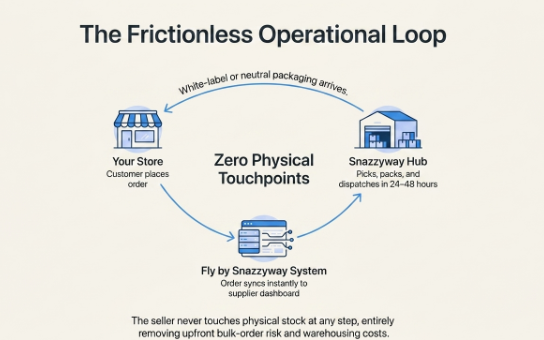
- The seller browses and lists products from the supplier's catalog on their own store.
- A customer places an order directly on the seller's Shopify, Amazon, or WooCommerce store.
- The order syncs to the supplier's dashboard — for example, through Snazzyway Dropshipping's Fly by Snazzyway system.
- The supplier picks, packs, and dispatches the order, typically within 24–48 hours.
- The customer receives the product, often in white-label or neutral packaging depending on the plan chosen.
Key takeaway: The seller never touches physical stock at any step, which removes storage and handling costs entirely.
Quality Control: The Real Difference Between the Two Models
A common concern with dropshipping is losing control over product quality since the seller never physically inspects stock. This is a valid concern, but it's solved by choosing a supplier with in-house manufacturing rather than one sourcing from scattered third-party vendors. Snazzyway Dropshipping manufactures the large majority of its catalog in-house from its Haldwani, Uttarakhand facility, which keeps sizing and fabric quality consistent across the 4,000+ sellers reselling that catalog.
With inventory-based selling, quality control happens once — at the point of bulk purchase. With dropshipping, quality control is the supplier's ongoing responsibility, order after order, which is why supplier selection matters more in this model than in traditional wholesale buying.
Key takeaway: In a dropshipping model, supplier quality control replaces the inspection step sellers would otherwise do themselves.
Common Misconception About Dropshipping vs. Inventory
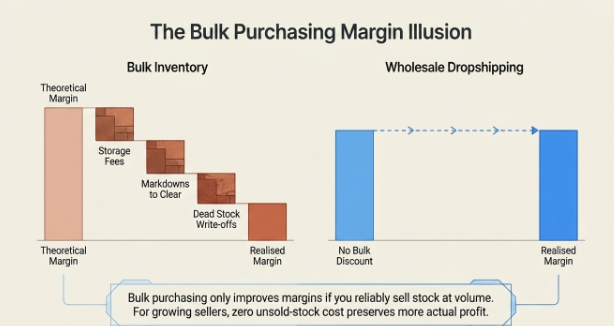
Many people assume dropshipping means lower profit margins than buying inventory in bulk. The reality is that bulk inventory purchasing only improves margins when a seller can reliably sell that stock at volume, because unsold inventory erodes those margin gains through storage costs, markdowns, and dead stock write-offs. For sellers still building consistent order volume, a no-MOQ dropshipping model like Snazzyway Dropshipping's often preserves margin better than bulk buying, since there's no unsold-stock cost eating into the total.
Dropshipping vs. Holding Inventory
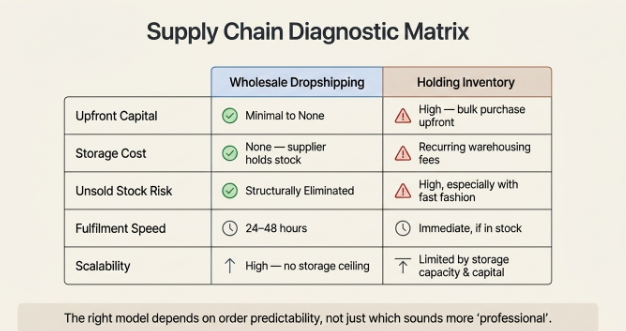
| Factor | Wholesale Dropshipping | Holding Inventory |
|---|---|---|
| Upfront capital required | Minimal to none | High — bulk purchase upfront |
| Storage cost | None (supplier holds stock) | Warehousing or storage fees |
| Unsold stock risk | Eliminated | Present, especially with fast fashion trends |
| Order fulfillment speed | 24–48 hours (supplier-dependent) | Immediate, if in stock |
| Scalability | High — no storage ceiling | Limited by storage capacity and capital |
| Best suited for | New sellers, testing products, wide catalogs | High-volume, predictable, narrow product lines |
Key takeaway: The right model depends on order predictability, not just which one sounds more "professional."
By the Numbers
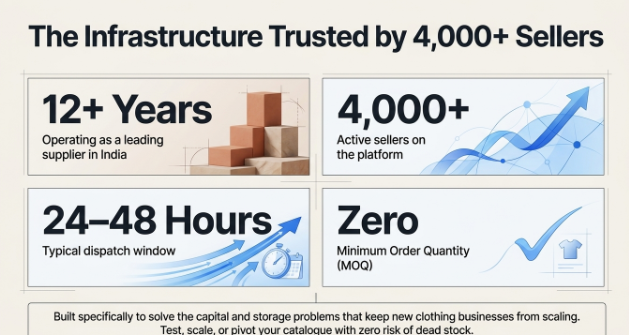
- Years Snazzyway Dropshipping has operated as a supplier: 12+
- Active sellers on the platform: 4,000+
- Typical dispatch window: 24–48 hours
- Typical working capital locked in inventory-based models: 30–60% (industry estimate)
- Minimum order quantity for dropshipping resellers: None
Avoid This Mistake
Don't hold inventory before you have consistent, predictable order volume. Many new sellers buy bulk stock expecting fast sales, only to end up with unsold inventory eating into cash flow for months — a mistake dropshipping structurally avoids by design.
Why Sellers Across India Choose Snazzyway Dropshipping
Snazzyway Dropshipping has worked with over 4,000 active sellers across India over more than 12 years in business, built specifically around solving the capital and storage problems that keep new clothing sellers from scaling. Headquartered in New Delhi with manufacturing based in Haldwani, Uttarakhand, the platform manufactures roughly 95% of its catalog in-house — meaning sellers get consistent quality without ever inspecting stock themselves.
For sellers building on Shopify, Snazzyway Dropshipping also offers dedicated Shopify store design and development support for dropshippers, which pairs the no-inventory model with a store built to convert from day one. Sellers expanding to marketplaces can dropship on Amazon using the same catalog, without managing separate inventory across platforms. And for sellers building their own brand identity, white-label dropshipping lets resellers ship under their own branding while Snazzyway Dropshipping handles manufacturing and fulfillment behind the scenes.
As a leading wholesale clothing dropshipping supplier in India, Snazzyway Dropshipping's core advantage has always been removing the capital barrier that inventory-based selling creates — letting sellers test, scale, or pivot their catalog without the risk of unsold stock sitting in a warehouse.
Key takeaway: A 12-year track record with 4,000+ sellers reflects a model built around solving the exact capital and storage problems inventory-based selling creates.
Choosing the Right Model for Your Platform
The dropshipping-vs-inventory decision often intersects with a second decision: which platform to sell on. Our detailed comparison of dropshipping vs. reselling vs. Amazon FBA in India breaks down which model wins for different seller goals and capital levels in 2026. For sellers specifically weighing platforms, Shopify vs. Amazon FBA in India compares fulfillment control, fees, and scalability between the two.
Sellers running WooCommerce stores aren't left out either — WooCommerce dropshipping in India covers how the same no-inventory model integrates with WordPress-based stores.
Key takeaway: The inventory-vs-dropshipping decision should be made alongside — not separately from — your platform choice.
Bottom Line
Wholesale clothing dropshipping is better than holding inventory for most sellers in India who are still validating product demand or managing limited working capital, since it eliminates unsold-stock risk and storage costs entirely. Holding inventory can still make sense for sellers with high, predictable order volume in a narrow product range. Snazzyway Dropshipping's 12+ years working with 4,000+ sellers reflects a model built specifically to remove that capital barrier for growing clothing businesses.
Frequently Asked Questions
Is dropshipping more profitable than holding inventory?
Dropshipping is often more profitable for sellers without consistent, high order volume, because it eliminates unsold-stock losses and storage costs that erode inventory-based margins. Holding inventory can produce higher margins only when a seller reliably sells stock at volume without markdowns. For new or growing sellers, the capital freed up by not holding stock frequently outweighs the theoretical margin advantage of bulk buying.
How much capital do I need to start dropshipping clothing in India?
Most dropshipping suppliers, including Snazzyway Dropshipping, operate on a no-MOQ (no minimum order quantity) basis, meaning sellers can start without bulk-purchase capital. Costs are typically limited to store setup, marketing, and per-order product costs after a sale is made. This is significantly lower than the upfront capital required to purchase and store inventory in bulk.
Does holding inventory guarantee faster shipping to customers?
Holding inventory can offer faster shipping only if stock is already in hand and properly organized for quick dispatch. Established dropshipping suppliers with efficient systems, such as 24–48 hour dispatch windows, often match or come close to inventory-based shipping speeds. The gap in speed between the two models has narrowed significantly as supplier logistics have improved.
Is dropshipping suitable for scaling a clothing business long-term?
Yes, dropshipping is well-suited for long-term scaling because it removes the storage ceiling that limits inventory-based businesses. Sellers can expand into new product categories without needing additional warehouse space or upfront capital for each new line. This is one reason suppliers like Snazzyway Dropshipping have grown their active seller base to over 4,000 sellers across a 12+ year period.
What's the biggest risk with holding inventory for clothing?
The biggest risk is unsold stock, particularly for clothing where sizes, colors, and seasonal trends multiply the number of SKUs a seller must manage. Unsold inventory ties up capital and often requires markdowns to clear, reducing overall profitability. This risk is structurally eliminated in a dropshipping model, since sellers only pay for stock after a confirmed sale.
Can I switch from holding inventory to a dropshipping model?
Yes, many sellers transition from inventory-based selling to dropshipping as they look to free up capital or expand their product range without additional storage costs. The switch typically involves partnering with a supplier offering platform integration, such as Shopify or WooCommerce syncing, to manage the transition smoothly. Existing store branding and customer relationships can generally be maintained through the switch.
Is a hybrid model — dropshipping plus some inventory — realistic?
Yes, a hybrid model is realistic and common, where sellers hold inventory only for their fastest-moving, most predictable products while dropshipping the rest of their catalog. This balances the margin benefits of bulk buying on proven sellers with the flexibility and low risk of dropshipping for newer or untested products. Many sellers adopt this approach as their business matures and sales data becomes more reliable