Print on Demand vs Dropshipping: Which Wins for Fashion Sellers in 2026?
This guide was last updated in June 2026 based on current market data.
Print on demand or dropshipping — which is more profitable? For most online fashion sellers, dropshipping is more profitable because it offers a wider product catalog, faster fulfilment, and no design or printing dependency. Print on demand works only when your product category supports custom printing, which rules out most lingerie, intimate wear, and structured apparel. If you're selling women's clothing or lingerie, dropshipping is almost always the better starting point.
Quick Summary Box
- Dropshipping suits unlimited product categories; print on demand is limited mostly to printable flat-surface items like t-shirts, mugs, and posters.
- Lingerie, shapewear, and structured women's wear cannot be print-on-demand products because they require pre-manufactured fit, fabric, and construction.
- Dropshipping profit margins in the women's fashion category typically range from 20% to 45%, based on observed patterns across active sellers, compared to 10–30% in general dropshipping.
- A reliable dropshipping supplier removes inventory risk the same way print on demand does, without limiting your catalog size.
- For fashion and lingerie sellers, supplier reliability and catalog depth matter more than design customization.
This guide is for women's fashion and lingerie sellers in India who want to choose between print on demand and dropshipping before launching or scaling their store.
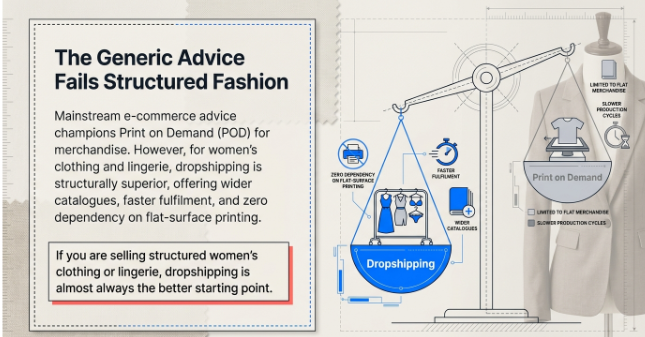
Most comparisons between print on demand and dropshipping are written for the t-shirt and merchandise crowd. They rarely address what happens when your product category is lingerie, shapewear, sleepwear, or structured women's fashion — categories where print on demand simply isn't an option. This guide breaks down both models specifically for fashion sellers, with real numbers, a step-by-step look at how each model works, and a clear answer on which one actually scales in 2026.
What Is Print on Demand and Where It Breaks Down for Fashion
Print on demand (POD) — a model where a design is printed onto a blank product only after a customer orders it, with no inventory held by the seller — works well for flat, printable goods like t-shirts, hoodies, mugs, and tote bags.
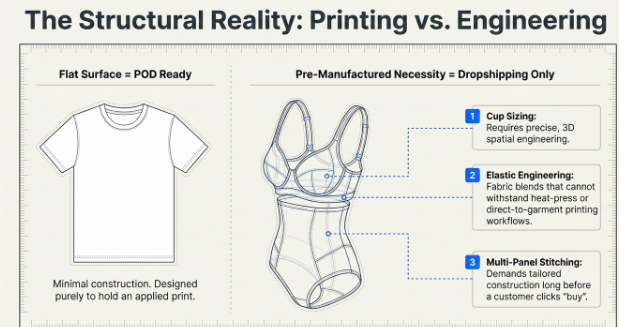
The problem for fashion sellers is structural, not creative. Lingerie, bras, shapewear, and fitted women's clothing involve cup sizing, elastic engineering, multi-panel stitching, and fabric blends that can't be "printed on demand" in any meaningful way. A print on demand partner can put a design on a basic cotton t-shirt; it cannot manufacture a properly fitted bra to order in the same workflow. Even where printing is technically possible on a fabric panel, the underlying garment still has to be constructed and stocked in advance by someone — which quietly turns "true" POD back into a dropshipping-style supply chain anyway.
Key takeaway: Print on demand works for flat printable goods, but it has no real application in lingerie or structured fashion categories.
What Is Dropshipping and Why It Fits Fashion Categories Better
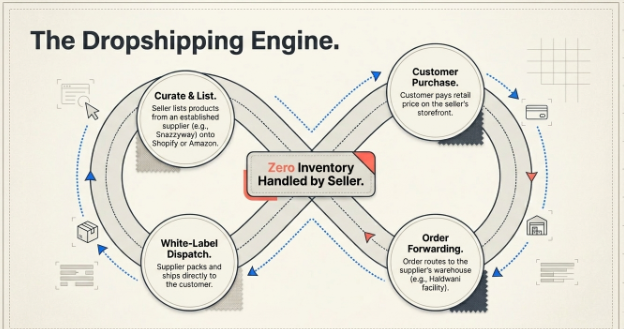
Dropshipping — a retail model where the seller never holds inventory, and orders are fulfilled directly by a supplier who manufactures, packs, and ships the product — works for any pre-manufactured product category, including lingerie, shapewear, sleepwear, and women's apparel.
This is the structural advantage for fashion sellers. A supplier like Snazzyway Dropshipping manufactures finished lingerie and women's clothing in advance, in proper sizes and fits, and ships it directly to the end customer the moment an order comes in. There's no design-and-print step standing between the order and the product, and no need to gamble on whether a printing process can replicate something that actually needs tailoring.
Key takeaway: Dropshipping suits any pre-manufactured product, which makes it the only realistic model for lingerie and fashion sellers.
How Fashion Dropshipping Works, Step by Step
- A seller picks a supplier with an established catalog — for example, a seller exploring how Snazzyway Dropshipping works before listing products.
- The seller lists products on their store (Shopify, Amazon, WooCommerce) with their own pricing and branding.
- A customer places an order on the seller's store.
- The seller forwards the order to the supplier, who packs and ships it directly to the customer, often under white-label branding.
- The seller keeps the margin between their retail price and the supplier's wholesale price.
Common Misconception About POD and Fashion
Many people assume print on demand and dropshipping are interchangeable models that differ only in branding control. The reality is they solve different manufacturing problems — POD handles on-demand customization of flat goods, while dropshipping handles distribution of pre-manufactured products — because lingerie and structured apparel require fit and construction that no print step can deliver.
Print on Demand vs Dropshipping for Fashion Sellers
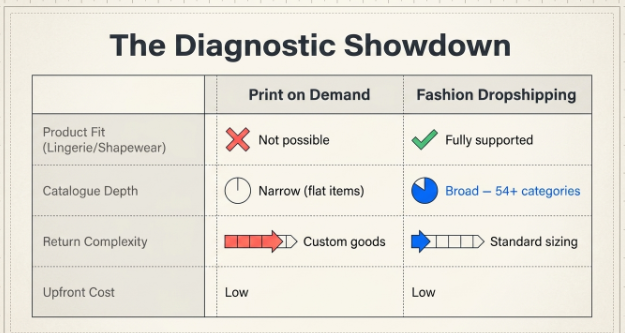
| Factor | Print on Demand | Dropshipping (Fashion Focus) |
|---|---|---|
| Product fit (lingerie/shapewear) | Not possible | Fully supported |
| Catalog depth | Narrow (printable items) | Broad — 54+ categories possible |
| Branding | Strong on flat goods | Achievable via white-label dropshipping |
| Upfront cost | Low | Low |
| Order fulfilment speed | 3–7 days typical | Varies by supplier, often 2–5 days domestically |
| Return complexity | High (custom-made goods) | Lower (standard sizing, return-friendly) |
By the Numbers
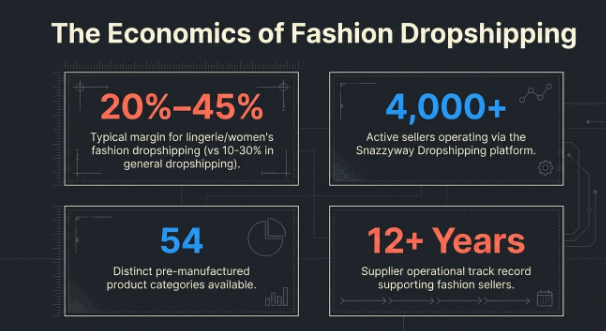
- Lingerie dropshipping margins: 20–45% based on observed patterns across active sellers
- General dropshipping margins: 10–30%
- Active sellers on Snazzyway Dropshipping's platform: 4,000+
- Snazzyway Dropshipping years in operation: 12+
- Product categories available: 54
Returns and Replacement Complexity in Fashion
Returns are where the two models diverge sharply once a fashion category is involved. In print on demand, a returned item is essentially a custom-made product that can't be resold to another customer, which is why many POD providers either restrict refunds or push return shipping costs back onto the seller. For a category like lingerie, where sizing returns are already common in regular retail, this becomes unworkable — a printed, made-to-order bra that doesn't fit can't simply be relisted.
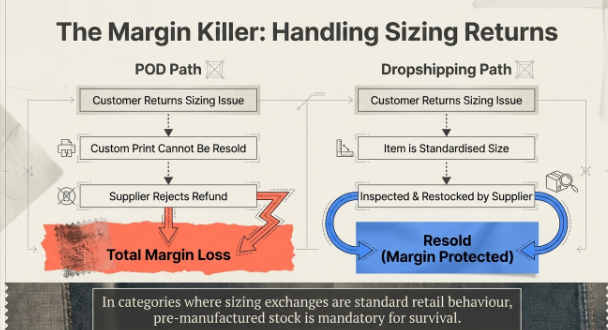
Dropshipping handles this far more cleanly because the products are standard, pre-manufactured stock rather than one-off prints. A returned item in the correct size and condition can usually be restocked and resold by the supplier, and established suppliers often build sizing guides, size-exchange policies, and quality checks into their process specifically to keep return rates manageable.
Key takeaway: standardized, pre-manufactured stock makes returns and exchanges far more manageable than custom-printed goods.
Marketing and Customer Service Differences for Fashion Sellers
Marketing a print-on-demand store usually leans on design originality — sellers promote a specific graphic, slogan, or art style, and customers buy into that creative identity. That approach doesn't transfer well to lingerie and women's fashion, where customers are evaluating fit, fabric quality, comfort, and trust in sizing far more than they're evaluating a printed design.
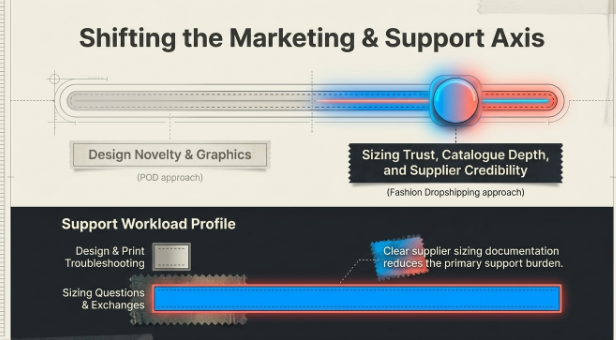
For fashion dropshipping, marketing instead centers on catalog breadth, consistent sizing accuracy, and supplier credibility — things like verified reviews, years in business, and transparent fulfilment timelines do more to convert buyers than a unique print ever could. Customer service follows the same pattern: a fashion seller's support workload is dominated by sizing questions and exchange requests, not design complaints, so working with a supplier that has clear sizing documentation and a track record reduces the support burden significantly.
Key takeaway: fashion marketing depends on sizing trust and catalog depth, not design novelty.
Avoid This Mistake When Choosing Between the Two Models
Picking print on demand because it sounds "more brandable." Many new fashion sellers assume POD automatically means stronger branding, then discover mid-setup that their product category (bras, shapewear, sleepwear) simply can't be produced that way, forcing a late pivot to dropshipping after wasted setup time.
Snazzyway Insight: Why Fashion Sellers Choose Dropshipping at Scale
We've worked with women's fashion and lingerie sellers for over 12 years, and the pattern is consistent: sellers who try to force lingerie into a print-on-demand model lose months before switching to a proper dropshipping supplier. Snazzyway Dropshipping currently supports 4,000+ active sellers across 54 product categories from our New Delhi base, with manufacturing and warehousing handled out of our Haldwani, Uttarakhand facility. Because every product is pre-manufactured to size before an order ever comes in, sellers skip the fit and construction problems that make POD unworkable for this category entirely.
Scaling also looks different once fit is involved. A POD seller scales by adding new designs to a fixed set of printable products, while a fashion dropshipping seller scales by adding new SKUs across an existing, already-manufactured catalog — which is why sellers working with established suppliers can expand into new fashion sub-categories far faster than a POD seller can expand into new printable product types.
If you're deciding how to launch, it helps to compare suppliers too — many sellers researching this also look at how Snazzyway compares with other Shopify suppliers in India before committing to one platform.
Where Print on Demand Still Has a Place
POD isn't useless for fashion brands — it just sits in a narrower lane. Sellers who want printed graphic tees, statement hoodies, or accessory add-ons alongside a core fashion line sometimes run a hybrid approach, using POD for flat printable add-ons while sourcing the actual fitted apparel through a dropshipping supplier. For sellers exploring that hybrid path, our breakdown of print-on-demand (POD) dropshipping for lingerie explains exactly where the two models can and can't overlap in this category.
Getting Started on the Platforms That Matter
Once you've settled on dropshipping, platform choice is the next decision. Sellers building on Shopify often start with our guide on how to start dropshipping on Shopify, while sellers targeting marketplace traffic instead usually look at how to dropship on Amazon. Both paths work with the same supplier catalog — the difference is just where your storefront lives, and which audience you're trying to reach first.
Branding also doesn't have to be sacrificed in dropshipping. Sellers who want their own labels on lingerie and apparel typically start with white label dropshipping, which lets you sell pre-manufactured products under your own brand name instead of the supplier's — closing the one gap that print on demand seemed to offer in the first place.
Bottom Line
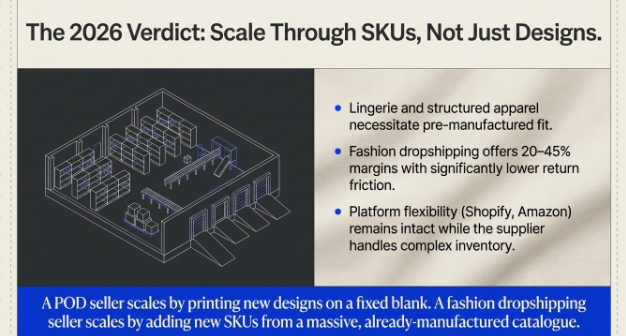
For fashion and lingerie sellers, dropshipping wins over print on demand because the product category itself rules POD out — lingerie and structured apparel need pre-manufactured fit and construction, not printed designs. Print on demand stays useful for graphic apparel and accessories, but it's not a real option for the core women's fashion catalog. Choose a supplier with deep category coverage, clear sizing data, and a track record, and build from there.
Frequently Asked Questions
1. Can lingerie be sold through print on demand?
No, lingerie cannot realistically be sold through print on demand because bras, shapewear, and similar products require pre-engineered fit, elastic construction, and multi-panel stitching that a print-after-order workflow can't produce. Print on demand only works on flat, printable surfaces like t-shirts or tote bags. For fitted fashion categories, dropshipping with a supplier that pre-manufactures finished products is the only practical path. This is why most fashion sellers default to dropshipping rather than POD.
2. Is dropshipping more profitable than print on demand for fashion sellers?
Yes, for fashion specifically, dropshipping tends to be more profitable because it allows access to a much wider catalog and avoids per-unit printing costs that eat into margins. Based on observed patterns across active sellers, lingerie and women's fashion dropshipping margins often run between 20% and 45%, depending on category and supplier pricing. Print on demand margins can be higher on niche printed goods, but that advantage doesn't apply to non-printable fashion categories like lingerie.
3. What's the biggest difference between print on demand and dropshipping?
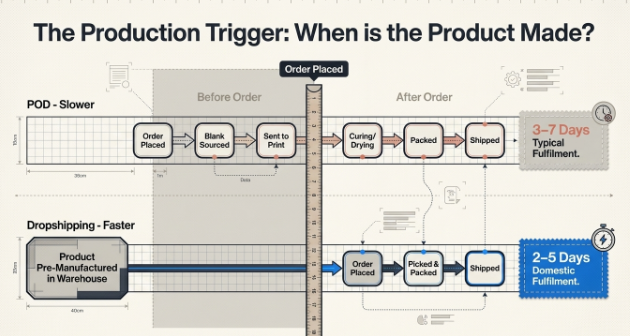
The biggest difference is the production trigger. Print on demand creates the product (usually by printing a design) only after an order is placed, while dropshipping ships an already-manufactured product directly from supplier to customer. Both avoid the seller holding inventory, but dropshipping supports a far wider range of finished-goods categories. For apparel that needs construction rather than printing, this difference becomes critical.
4. Can I start dropshipping with low investment?
Yes, dropshipping generally requires minimal upfront investment since you don't purchase stock until a customer has already paid for it. Your main costs are setting up your storefront, basic marketing, and any platform fees. Suppliers offering ready catalogs reduce the setup time further, since you don't need to source products individually. This makes dropshipping accessible to new sellers entering the women's fashion space.
5. How fast is order fulfilment in fashion dropshipping compared to POD?
Fulfilment speed varies by supplier, but dropshipping often ships in 2 to 5 days domestically once a reliable supplier with existing stock is involved, compared to print on demand's typical 3 to 7 day window due to the printing step. Faster fulfilment generally improves customer satisfaction and reduces return requests. Sellers should always confirm shipping timelines directly with their chosen supplier before listing products.
6. Can I build my own brand with dropshipping, or only with print on demand?
You can build your own brand with dropshipping through white label arrangements, where products are shipped under your brand name rather than the supplier's. This removes one of the main reasons sellers assume print on demand is necessary for branding. White label dropshipping is especially common in the lingerie and women's apparel space, where suppliers manufacture finished products that sellers then brand and sell as their own.
7. Which model should a beginner choose for women's fashion?
A beginner targeting women's fashion or lingerie should choose dropshipping, since print on demand isn't a viable production method for most fitted apparel categories. Starting with a supplier that offers an established catalog, consistent sizing, and reliable fulfilment reduces early-stage risk. From there, sellers can decide on platform (Shopify, Amazon, or their own storefront) based on where their target customers shop.