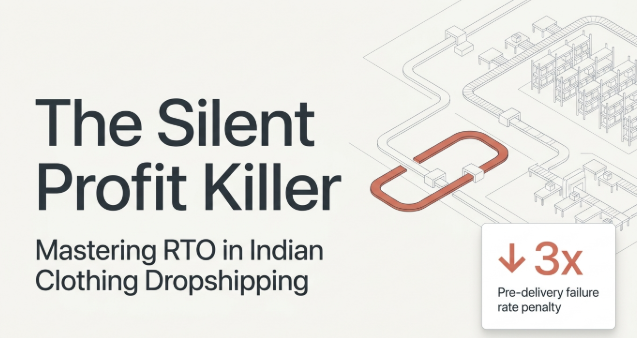
Why Does Return-to-Origin Rate Matter So Much for Clothing Dropshipping in India?
Why does RTO rate matter for clothing dropshipping in India?
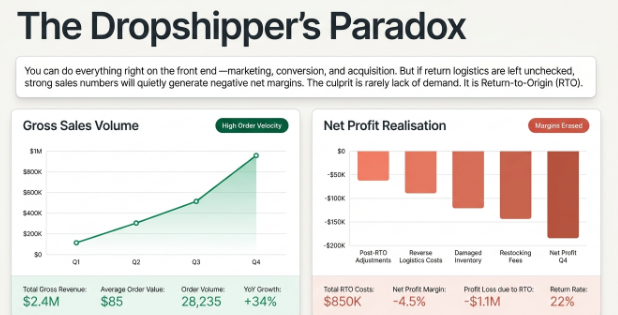
Return-to-Origin (RTO) rate matters because every RTO order costs a seller shipping fees twice — once to the customer, once back to the warehouse — without any revenue to show for it. In clothing dropshipping specifically, RTO rates run higher than most categories due to sizing uncertainty and cash-on-delivery refusals. Sellers who track and reduce RTO directly protect their margins; those who ignore it often find their profits quietly erased by return logistics costs.
Quick Summary
- RTO (Return-to-Origin) refers to an order that a customer refuses or fails to receive, sending it back to the seller or supplier's warehouse.
- Clothing dropshipping in India typically sees higher RTO rates than electronics or non-apparel categories, due to sizing and fit issues.
- Snazzyway Dropshipping has worked with 4,000+ active sellers over 12+ years, giving it substantial data on RTO patterns across categories.
- Cash-on-delivery (COD) orders carry significantly higher RTO risk than prepaid orders, based on industry patterns.
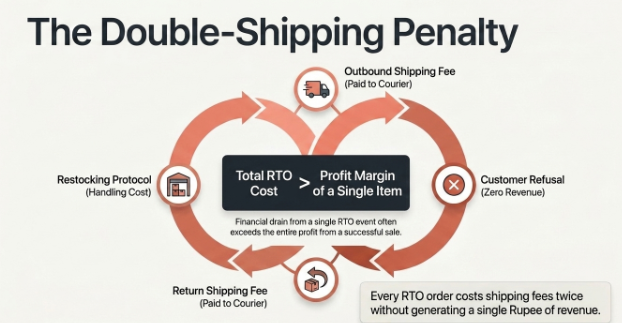
- Each RTO order costs a seller two-way shipping charges plus restocking effort, directly reducing net margin.
- Suppliers with in-house quality control and accurate size charts tend to see measurably lower RTO rates.
Who this is for: This guide is for Shopify, Amazon, and WooCommerce sellers in India running or planning a clothing dropshipping business who want to protect their margins from return logistics losses.
Introduction
RTO is one of the least discussed but most damaging costs in Indian dropshipping. A seller can have strong sales numbers and still lose money if a large share of those orders come back unclaimed. Clothing is especially exposed to this risk because size, fit, and COD refusals compound the problem in ways other product categories don't face as heavily. This post breaks down what RTO actually costs sellers, why clothing dropshipping is uniquely vulnerable, and what to look for in a supplier to keep RTO rates manageable.
What RTO Actually Means for a Dropshipping Seller
Return-to-Origin (RTO) — an order that fails delivery, either refused by the customer or undeliverable, and is shipped back to the seller or supplier's warehouse.
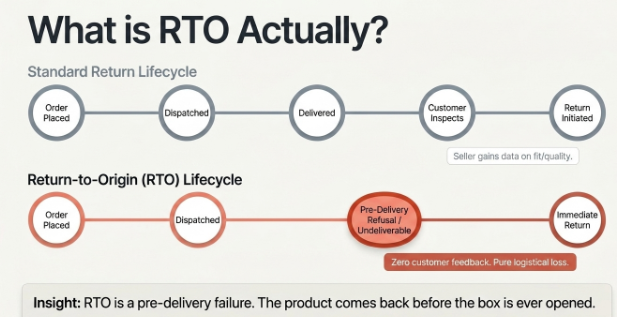
RTO is different from a standard return. A standard return happens after the customer receives and inspects the product. RTO happens before delivery is even completed — the courier attempts delivery, the customer refuses or is unreachable, and the package heads back. For clothing sellers, this distinction matters because RTO orders generate zero customer feedback on fit or quality, yet still carry the full shipping cost of a completed order.
Based on patterns observed across suppliers working with thousands of sellers — including Snazzyway Dropshipping's base of 4,000+ active sellers over 12+ years — RTO in clothing categories tends to run higher than in electronics, accessories, or home goods, largely because clothing has more decision points that can go wrong after the order is placed.
Key takeaway: RTO is a pre-delivery failure, which means it costs money without ever generating customer feedback to learn from.
Why Clothing Has a Higher RTO Rate Than Other Categories
Cash-on-delivery (COD) — a payment method where the customer pays at the time of delivery rather than online at checkout.
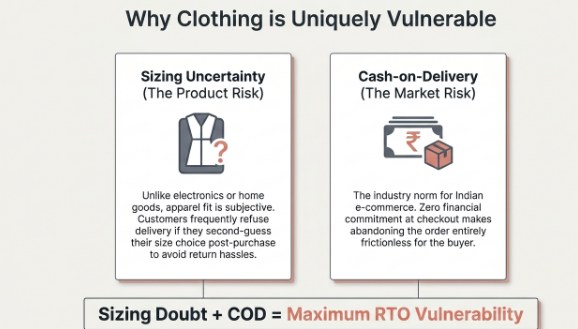
Clothing dropshipping in India relies heavily on COD, since many customers still prefer to pay after receiving the product — especially for apparel, where fit is a concern. COD orders carry meaningfully higher RTO risk than prepaid orders, based on industry patterns, because there's no financial commitment locking the customer into accepting delivery. If a customer changes their mind, orders a competing product elsewhere, or simply isn't home, the order comes back at the seller's cost.
Sizing adds a second layer of risk specific to clothing. Unlike a phone case or a kitchen gadget, a clothing item can be "wrong" in a size that photos and descriptions can't fully prevent — leading some customers to refuse delivery outright rather than deal with an exchange later.
Key takeaway: COD reliance and sizing uncertainty combine to make clothing one of the higher-RTO categories in Indian e-commerce.
How RTO Impacts a Seller's Margin Step by Step
- The seller ships an order and pays outbound shipping to the courier.
- The customer refuses delivery or is unreachable at the delivery address.
- The courier returns the package, and the seller pays return shipping as well.
- The product is restocked — assuming it's undamaged — adding handling time and cost.
- The seller absorbs both shipping costs with zero revenue from that order.
Key takeaway: A single RTO order can cost more in logistics fees than the seller's profit margin on that item.
What Sellers Can Control to Reduce RTO
Restocking — the process of returning an unsold or returned item back into sellable inventory after inspection.
While RTO can never be eliminated entirely, sellers and suppliers can reduce it through better upfront information. Accurate, detailed size charts reduce sizing-related refusals. Order confirmation calls or SMS verification before dispatch catch fake or accidental orders before they ship. And suppliers with consistent in-house quality control reduce the chance that a customer refuses an order due to visible quality issues on arrival.
Snazzyway Dropshipping's approach to this has been shaped by 12+ years of working directly with 4,000+ sellers across India, giving it visibility into which categories and product types tend to see higher RTO, and adjusting size documentation and product descriptions accordingly.
Key takeaway: RTO reduction comes from prevention — accurate information and verification — not from chasing returns after they happen.
Common Misconception About RTO in Dropshipping
Many people assume RTO is mainly a courier or logistics problem outside a seller's control. The reality is that a large share of RTO is preventable at the listing and order-confirmation stage, because unclear sizing information and unverified COD orders are two of the biggest drivers of refused deliveries, according to patterns observed across established dropshipping suppliers. Sellers who invest in clear product information and order verification typically see measurably lower RTO than those who don't.
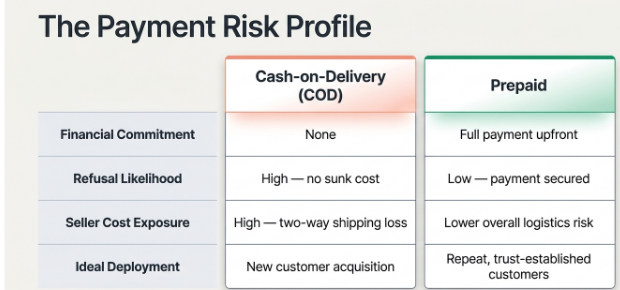
RTO Risk: COD vs Prepaid Orders
| Factor | COD Orders | Prepaid Orders |
|---|---|---|
| Financial commitment at order time | None | Full payment upfront |
| Typical RTO risk | Higher | Lower |
| Customer refusal likelihood | Higher — no sunk cost | Lower — payment already made |
| Suited for | New customer acquisition | Repeat, trust-established customers |
| Seller cost exposure | Higher, due to two-way shipping on refusals | Lower overall logistics risk |
Key takeaway: A healthy mix of COD and prepaid orders, weighted toward prepaid where possible, structurally reduces overall RTO exposure.
By the Numbers
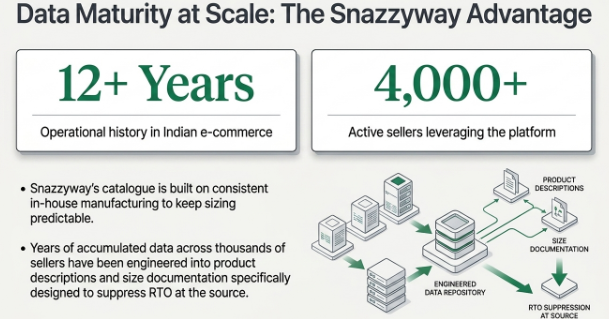
- Years Snazzyway Dropshipping has worked with sellers across India: 12+
- Active sellers on the platform: 4,000+
- Category most exposed to RTO in Indian dropshipping: Clothing and apparel
- Primary RTO driver in clothing: Sizing uncertainty and COD refusals
- Key RTO reduction levers: Size charts, order verification, in-house quality control
Avoid This Mistake
Don't rely on COD orders without any order verification step. Unverified COD orders are one of the largest contributors to RTO in clothing dropshipping, because customers face zero cost for refusing delivery, so a simple confirmation call or SMS before dispatch can meaningfully cut RTO losses.
Why Supplier Choice Directly Affects Your RTO Rate
RTO isn't only a seller-side problem — the supplier a seller partners with plays a direct role in how often orders come back. A supplier with accurate, detailed size charts, consistent in-house manufacturing, and clear product photography reduces the sizing and quality surprises that drive refusals. Snazzyway Dropshipping has built this into its process over 12+ years working with 4,000+ active sellers, using consistent in-house manufacturing to keep sizing and quality predictable across the catalog — a factor that directly reduces the "product didn't match expectations" driver of RTO.
Sellers building on Shopify can further reduce RTO through better product page design and clearer sizing presentation — something covered in Snazzyway Dropshipping's Shopify store design and development support for dropshippers. For sellers expanding onto marketplaces, where RTO dynamics differ from a self-hosted store, the dropship on Amazon service handles fulfillment logistics with Amazon's own delivery infrastructure factored in. And sellers building their own brand can reduce return friction through white-label dropshipping, where consistent branded packaging builds the customer trust that reduces refusal rates over time.
As a leading wholesale clothing dropshipping supplier in India, Snazzyway Dropshipping's scale — 4,000+ sellers over 12+ years — has given it the data and process maturity to address RTO at the product and fulfillment level, rather than leaving sellers to absorb the cost alone.
Key takeaway: Choosing a supplier with strong sizing accuracy and quality consistency is one of the most effective ways to lower RTO before it happens.
Where RTO Fits Into Your Broader Platform Strategy
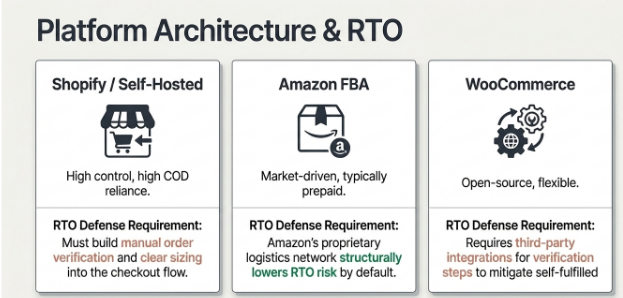
RTO rates can also vary depending on which platform and fulfillment model a seller uses. Our comparison of dropshipping vs. reselling vs. Amazon FBA in India covers how return and RTO dynamics differ across these models, since FBA orders are typically prepaid and handled through Amazon's own logistics network, which structurally lowers RTO risk compared to self-fulfilled COD orders.
For sellers deciding between platforms, our Shopify vs. Amazon FBA in India guide also breaks down how fulfillment control affects return logistics costs. And for WooCommerce sellers managing their own store infrastructure, WooCommerce dropshipping in India covers integration options that support order verification steps to help reduce RTO.
Key takeaway: RTO risk should factor into platform and fulfillment model decisions, not just be treated as a fixed cost of doing business.
Bottom Line
RTO rate matters for clothing dropshipping in India because it directly erodes margins through double shipping costs on orders that never complete — and clothing is uniquely exposed due to sizing uncertainty and COD reliance. Sellers reduce RTO most effectively by choosing suppliers with accurate sizing and consistent quality, and by verifying COD orders before dispatch. Snazzyway Dropshipping's 12+ years working with 4,000+ sellers reflects the kind of process maturity that helps address RTO at the source.
Frequently Asked Questions
What is a good RTO rate for clothing dropshipping in India?
A lower RTO rate is always better, and sellers should aim to keep it as close to single digits as possible, though clothing categories often run higher than other product types due to sizing and COD factors. Suppliers with strong quality control and accurate sizing information tend to help sellers achieve lower RTO than industry averages. Tracking RTO rate consistently over time is more useful than comparing to a single fixed benchmark.
Why is COD linked to higher RTO in clothing dropshipping?
COD is linked to higher RTO because customers make no financial commitment at the time of ordering, making it easy to refuse delivery without any cost to themselves. This is especially pronounced in clothing, where sizing uncertainty gives customers an additional reason to decline. Order verification steps, such as confirmation calls before dispatch, help reduce this risk significantly.
Does RTO affect prepaid orders too?
Yes, but at a much lower rate than COD orders, since prepaid customers have already committed financially and are less likely to refuse delivery. Prepaid RTO typically stems from address issues or courier delivery problems rather than customer refusal. Encouraging prepaid orders where possible is one of the more effective ways to structurally lower overall RTO exposure.
How does supplier quality control reduce RTO?
Supplier quality control reduces RTO by minimizing the chance that a product arrives with visible defects, incorrect sizing, or quality that doesn't match the listing photos — all common reasons for delivery refusal. Suppliers with in-house manufacturing, like those maintaining consistent production standards, tend to see fewer quality-related refusals. This is a key reason supplier selection matters as much as logistics choices in managing RTO.
Can accurate size charts really reduce RTO in clothing dropshipping?
Yes, accurate and detailed size charts directly address one of the most common RTO drivers in clothing — customers refusing delivery due to sizing concerns before the product even arrives. Clear measurements, fit guidance, and consistent sizing across a supplier's catalog reduce the uncertainty that leads to refusals. This is one of the simpler, most cost-effective RTO reduction strategies available to sellers.
Is RTO rate different across Shopify, Amazon, and WooCommerce?
Yes, RTO dynamics vary by platform because fulfillment models differ significantly. Amazon FBA orders are typically prepaid and fulfilled through Amazon's logistics network, which tends to lower RTO compared to self-fulfilled COD orders common on Shopify and WooCommerce stores. Sellers on self-hosted platforms benefit most from building order verification and clear sizing information directly into their own checkout process.
How many sellers has Snazzyway Dropshipping worked with, and does that experience help with RTO?
Snazzyway Dropshipping has worked with 4,000+ active sellers across India over 12+ years in business, giving it substantial cumulative data on return and RTO patterns across product categories. This experience has shaped how the platform approaches sizing documentation, quality control, and fulfillment processes to help reduce RTO exposure for sellers using its catalog. Long-standing suppliers with this scale of data are generally better positioned to help sellers manage RTO than newer or smaller suppliers.