Dropshipping on WhatsApp: How to Start & Automate Your Store
This guide was last updated in June 2026 based on current market data.
Can you really run a dropshipping business through WhatsApp?
Yes, WhatsApp dropshipping works especially well in India because most customers already use the app daily, making it a low-friction way to take orders, share catalogs, and handle customer service without building a full website first. It works best as a starting point or a parallel sales channel alongside a proper store, not as a complete replacement for one. To start, you set up a WhatsApp Business account, connect a product catalog, and pair it with a reliable supplier who can fulfil orders as they come in.
Quick Summary Box
- WhatsApp Business accounts let sellers create a product catalog directly inside the app, without needing a separate website.
- India has hundreds of millions of active WhatsApp users, making it one of the most-used communication apps in the country, according to industry estimates.
- WhatsApp dropshipping works best for sellers testing a niche or selling to a local or regional audience before scaling to a full online store.
- Automation tools and WhatsApp Business API integrations allow sellers to handle order confirmations and updates without manually replying to every message.
- Lingerie and women's fashion sellers often use WhatsApp for the trust and privacy it offers compared to public storefronts.
- A WhatsApp-only sales channel still needs a reliable supplier behind it, since the app handles communication, not fulfilment.
This guide is for small and growing dropshipping sellers in India who want to use WhatsApp to take orders and build customer relationships, with or without a full website.
WhatsApp dropshipping has grown quietly into one of the most practical starting points for new sellers in India, particularly in categories like fashion and lingerie where personal trust matters as much as price. This guide explains exactly how to set up a WhatsApp-based dropshipping workflow, where it works best, where it falls short, and how to automate it so it doesn't turn into an inbox you can't keep up with.
What WhatsApp Dropshipping Actually Means
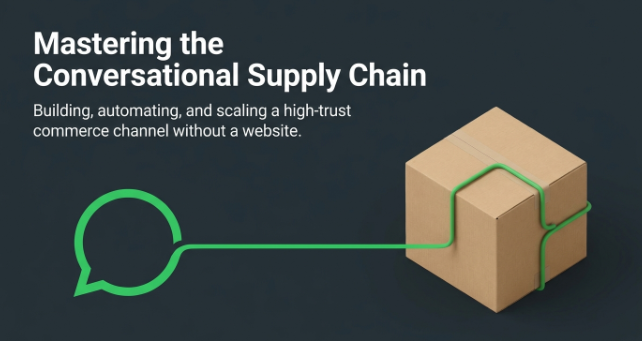
WhatsApp dropshipping — a sales model where a seller uses WhatsApp to share a product catalog, take customer orders, and manage communication, while a supplier handles manufacturing and shipping — works because it removes two early barriers for new sellers: building a website and learning ad platforms.
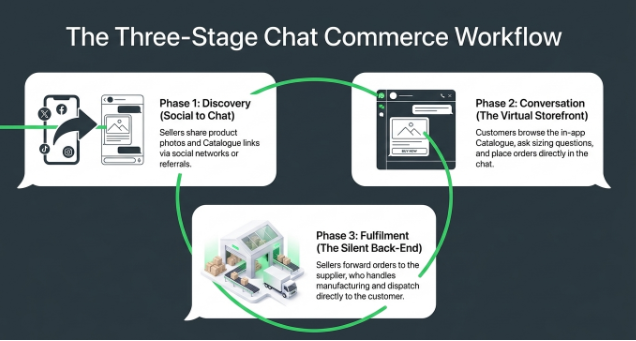
Instead of directing traffic to a Shopify store, a seller shares product photos or a WhatsApp Catalog link through Instagram, Facebook groups, or word of mouth, and customers message directly to place an order. The seller then forwards that order to their supplier for fulfilment, just like they would from any other sales channel.
Key takeaway: WhatsApp dropshipping replaces the storefront with a chat-based catalog, while the supplier still handles manufacturing and shipping exactly as in any other dropshipping setup.
Why WhatsApp Works So Well for Indian Sellers
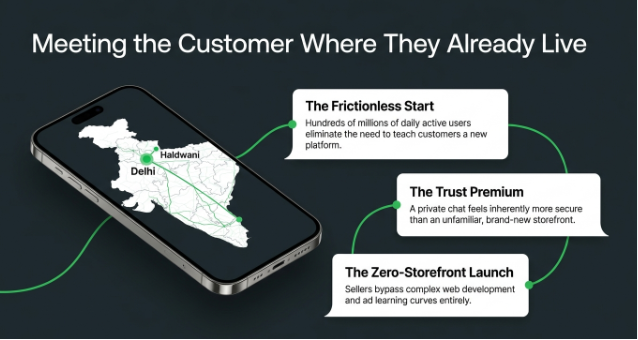
India has one of the largest WhatsApp user bases in the world, and the app is already the default communication tool for personal and business conversations across most age groups and cities, from Delhi to smaller towns like Haldwani. This existing familiarity is the biggest reason WhatsApp dropshipping converts well — customers don't need to learn a new platform or trust an unfamiliar website; they're simply continuing a conversation in an app they already use daily.
For categories like lingerie and women's intimate wear, this familiarity carries extra weight. Many customers feel more comfortable asking sizing questions or discussing product details in a private chat than browsing a public storefront, which is one reason WhatsApp has become a meaningful sales channel specifically in this category.
Key takeaway: WhatsApp's existing trust and daily usage in India make it a lower-friction sales channel than a brand-new, unfamiliar website.
How to Set Up WhatsApp for Dropshipping, Step by Step
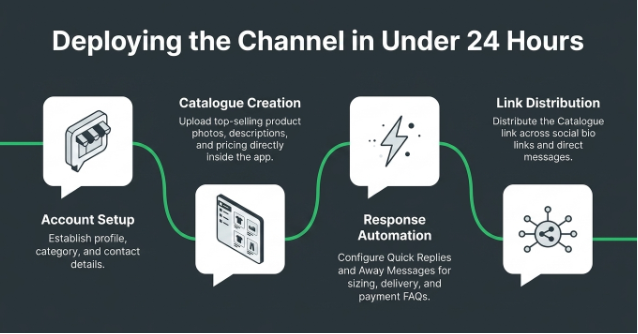
- Download WhatsApp Business (free) and set up a business profile with your store name, category, and contact details.
- Create a Catalog inside the app, uploading product photos, prices, and short descriptions for your top-selling items.
- Set up Quick Replies and an Away Message so common questions (sizing, delivery time, payment options) get answered instantly, even when you're not online.
- Share your Catalog link through Instagram bio links, Facebook posts, or directly with interested customers.
- When an order comes in, confirm the details with the customer, then forward the order to your supplier for packing and shipping.
Common Misconception About WhatsApp Dropshipping
Many people assume WhatsApp dropshipping means manually replying to every single message forever, which doesn't scale. The reality is that WhatsApp Business already includes automation tools like Quick Replies, Away Messages, and labels, and sellers who outgrow these can connect to the WhatsApp Business API for more advanced automation, so the manual-reply bottleneck is solvable rather than a permanent limitation.
WhatsApp Dropshipping vs a Full Shopify Store
| Factor | WhatsApp Dropshipping | Full Shopify Store |
|---|---|---|
| Setup time | Same day | A few hours to a few days |
| Upfront cost | Free (Business app) | Monthly subscription required |
| Discoverability | Limited to direct shares and referrals | Searchable, can run paid ads at scale |
| Order management | Manual or semi-automated via API | Fully automated checkout and tracking |
| Best for | Testing a niche, local/regional sales, trust-based categories | Scaling, paid advertising, wider reach |
| Payment collection | Manual (UPI, COD) | Integrated checkout and payment gateways |
WhatsApp and Shopify aren't really competitors — most sellers eventually run both, using WhatsApp for personal customer relationships and order support while Shopify handles discovery, checkout, and scale. If you're setting up your first proper online store alongside your WhatsApp channel, our guide on how to start dropshipping on Shopify walks through the full setup process.
By the Numbers
- WhatsApp Business app cost: free to download and use
- Typical setup time for a basic WhatsApp Catalog: under a day
- WhatsApp Business API: required for advanced automation at higher order volumes
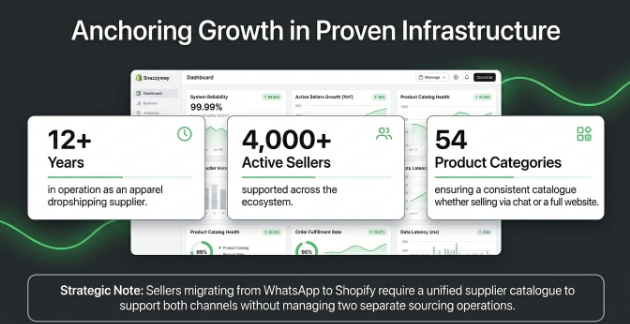
- Snazzyway Dropshipping years in operation: 12+
- Active sellers supported: 4,000+
Avoid This Mistake When Running WhatsApp Dropshipping
Treating WhatsApp as a permanent replacement for a real store instead of a starting point. Many sellers get early traction on WhatsApp and never build a proper storefront, which caps their growth because WhatsApp has no built-in discovery — every sale depends on someone already finding you through another channel first.
Automating WhatsApp So It Doesn't Become a Full-Time Inbox
As order volume grows, manually replying to every message becomes unsustainable, which is where automation tools matter. The WhatsApp Business API — a paid, developer-level integration that connects WhatsApp to external tools for automated messaging, chatbots, and order tracking — allows sellers to send automatic order confirmations, shipping updates, and even basic FAQ responses without a human typing each reply.
For sellers not ready for the API, simpler tools like saved Quick Replies for sizing charts, delivery timelines, and payment instructions cover most repetitive questions. Labels inside WhatsApp Business also help sellers organise chats into categories like "New Order," "Pending Payment," and "Shipped," which keeps a growing volume of conversations from turning into chaos.
Key takeaway: Automation tools exist specifically to stop WhatsApp dropshipping from collapsing under its own message volume as a store scales.
Snazzyway Insight: Why Fulfilment Matters More Than the Sales Channel
As an apparel dropshipping supplier in India, we've supported 4,000+ active sellers across 54 product categories for over 12 years, and one thing has stayed consistent regardless of whether a seller takes orders through WhatsApp, Instagram, or a full Shopify store: the sales channel only works if the fulfilment behind it is reliable. A seller can build a perfect WhatsApp catalog and respond to every message instantly, but if the supplier behind it ships late or sends the wrong size, the customer relationship built through that personal chat breaks just as fast as it formed.
This is one reason many of our sellers running WhatsApp-based stores still rely on a consistent supplier catalog with predictable sizing and dispatch timelines, since the trust WhatsApp builds in the conversation has to be backed up by what actually arrives at the customer's door. Sellers exploring how Snazzyway Dropshipping works often start exactly here — confirming the fulfilment side is solid before investing time into building out a WhatsApp sales channel.
Inside our Fly by Snazzyway dashboard, the Smart Export feature also helps sellers who eventually want to move from a WhatsApp-only setup to a full storefront, since it allows one-click product import into Shopify once a seller is ready to scale beyond manual order-taking.
What to Sell on WhatsApp: Categories That Work Best
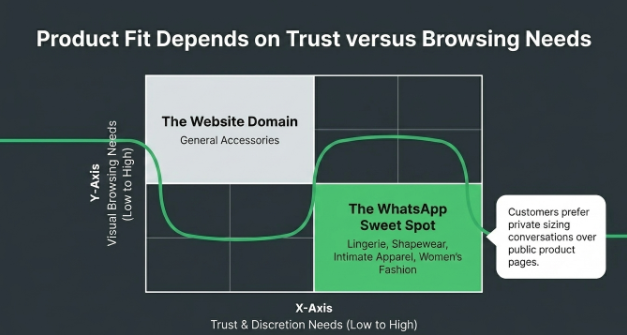
Not every product category suits WhatsApp dropshipping equally well. Categories that depend heavily on visual browsing across hundreds of SKUs, like general accessories, tend to work better on a searchable storefront. Categories where personal trust, sizing conversations, and discretion matter — lingerie, shapewear, and intimate wear among them — often perform unusually well on WhatsApp precisely because customers prefer a private conversation over a public product page when asking sizing or fit questions.
Sellers running both a WhatsApp channel and a broader catalog sometimes also explore print-on-demand (POD) dropshipping for lingerie to understand which parts of their catalog could work as printed accessories alongside their core fitted apparel line, even though POD itself isn't viable for the fitted items.
Key takeaway: WhatsApp performs best for trust-sensitive, conversation-driven categories rather than high-volume, visually-browsed catalogs.
Payments and Order Confirmation on WhatsApp
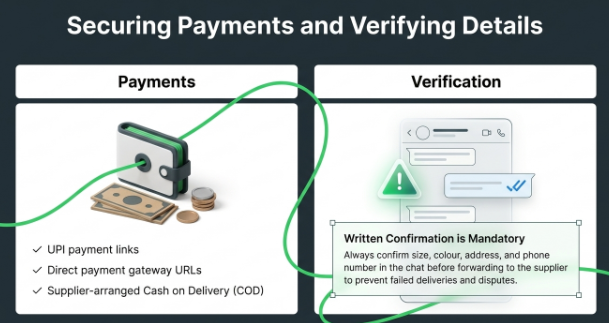
Since WhatsApp doesn't have a built-in checkout system, payment collection usually happens through UPI links, payment gateway links shared in chat, or Cash on Delivery arranged through the supplier. Sellers should always confirm the order details — size, colour, address, and phone number — directly in the chat before forwarding it to their supplier, since this step doubles as basic order verification and helps prevent the kind of address or detail errors that lead to failed deliveries later.
For sellers expanding beyond WhatsApp into marketplace sales as well, our guide on how to dropship on Amazon explains how the same supplier relationship can support both a personal WhatsApp channel and a marketplace listing without managing two completely separate sourcing setups.
Key takeaway: WhatsApp order confirmation should always happen in writing within the chat, since it protects both the seller and the customer if a dispute comes up later.
Branding on a Channel That Has No Storefront
One challenge specific to WhatsApp dropshipping is branding — there's no homepage, no custom design, no "About Us" page to build trust the way a website does. Sellers compensate for this by keeping their WhatsApp Business profile complete (photo, description, business hours, address if applicable) and by maintaining consistent packaging and branding on the physical product itself, even though the digital experience is just a chat thread.
This is where white label dropshipping becomes particularly useful for WhatsApp sellers — since the conversation itself can't carry much branding, the unboxing experience becomes the main place a customer actually sees your brand identity, which makes white-labelled packaging more important on this channel than on a fully designed website.
When to Move Beyond WhatsApp-Only Selling
Most sellers eventually hit a ceiling with WhatsApp-only sales, usually around the point where manually managing chats starts eating more time than it saves. Common signs include missed messages during busy hours, difficulty tracking which orders are pending payment versus shipped, and customers asking if you have a "real website" before trusting a larger purchase. At this stage, pairing WhatsApp with a proper Shopify store — while keeping WhatsApp open as a support and order-confirmation channel — tends to work better than trying to scale chat-based selling indefinitely. Sellers comparing supplier options before making this move often review how Snazzyway compares with other Shopify suppliers in India to confirm the same supplier catalog will support both their WhatsApp channel and their new storefront.
Key takeaway: WhatsApp works well as a starting channel, but most growing sellers eventually pair it with a searchable storefront rather than replacing it entirely.
Bottom Line
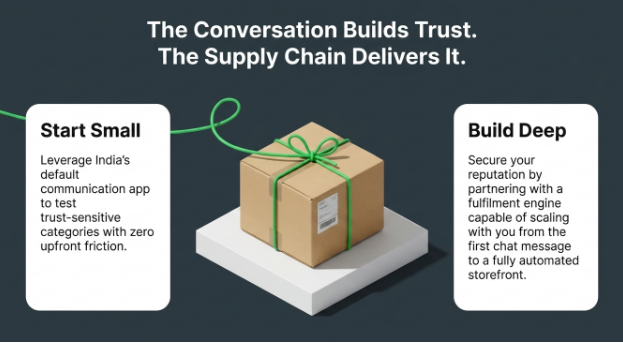
WhatsApp dropshipping works well in India because it meets customers in an app they already trust and use daily, making it especially effective for trust-sensitive categories like lingerie and women's fashion. It's best treated as a starting point or parallel channel rather than a permanent replacement for a full online store, since WhatsApp has no built-in discovery of its own. Whatever channel you sell through, the supplier behind your orders ultimately determines whether the trust you build in conversation actually gets honoured at the customer's doorstep.
Frequently Asked Questions
1. Is WhatsApp dropshipping legal in India?
Yes, WhatsApp dropshipping is legal in India, since it's simply a communication channel used for taking orders, similar to a phone call or email. Sellers still need to follow standard ecommerce regulations around GST, business registration where applicable, and consumer protection rules, regardless of which channel they use to take orders. WhatsApp itself doesn't require any special licensing for business use beyond setting up a WhatsApp Business account.
2. Do I need a website to start dropshipping on WhatsApp?
No, a website isn't required to start, which is one of the main reasons WhatsApp dropshipping appeals to new sellers. A WhatsApp Business Catalog can function as a basic product listing on its own, letting customers browse and message directly without visiting a separate site. However, most sellers eventually add a website or Shopify store once order volume grows beyond what manual chat management can handle.
3. How do I take payments through WhatsApp dropshipping?
Payments on WhatsApp are typically collected through UPI payment links, shared payment gateway links, or Cash on Delivery arranged with the supplier at the time of shipping. WhatsApp itself doesn't include a built-in checkout system, so sellers need to manage payment confirmation manually within the chat before forwarding the order for fulfilment. Keeping a written record of the confirmed order details in the chat also helps avoid disputes later.
4. Can WhatsApp dropshipping be automated?
Yes, WhatsApp Business includes basic automation tools like Quick Replies, Away Messages, and chat labels that handle common repetitive questions automatically. For higher order volumes, the WhatsApp Business API allows more advanced automation, including automatic order confirmations and shipping updates through external tools. Most sellers start with the free Business app's built-in automation and move to the API only once message volume becomes difficult to manage manually.
5. Is WhatsApp better than Instagram for dropshipping?
WhatsApp and Instagram serve different purposes rather than directly competing — Instagram is generally better for discovery and reaching new customers through content and ads, while WhatsApp is better for closing sales and building one-on-one trust once someone is already interested. Most successful dropshipping sellers use both together, driving discovery through Instagram and handling order conversations through WhatsApp. Relying on only one of the two usually limits either reach or conversion.
6. What products sell best through WhatsApp dropshipping?
Products that benefit from personal conversation and trust, such as lingerie, sizing-sensitive apparel, and intimate wear, tend to perform particularly well on WhatsApp because customers often prefer discussing fit and sizing privately rather than browsing a public storefront. High-volume, visually-driven categories with hundreds of SKUs generally perform better on a searchable website instead. Matching the product category to the channel's natural strengths improves conversion more than trying to force every product type into a chat-based sales process.
7. When should I move from WhatsApp-only selling to a full online store?
The right time to expand beyond WhatsApp is usually when manually managing chats starts costing more time than it saves, or when customers start asking for a proper website before trusting a purchase. At this point, most sellers keep WhatsApp running as a support and order-confirmation channel while building a Shopify store for discovery, checkout, and scale. Choosing a supplier whose catalog works across both channels avoids the need to manage two separate sourcing relationships during this transition.